
Introduction
Compliance is the part of running a business nobody wants to think about — until they have to.
The FTA audit that reveals three years of invoicing errors. The employment dispute that reaches MoHRE because the contract was missing mandatory clauses. The corporate tax filing that was missed because nobody tracked the deadline. The data breach that triggers a TDRA investigation because there was no privacy policy in place.
Every one of these scenarios is avoidable. None of them are rare. And in the UAE, where the regulatory environment has evolved significantly since VAT was introduced in 2018 — adding Corporate Tax, the new Labour Law, the Personal Data Protection Law, and an expanding AML framework — the gap between what businesses think they are complying with and what they are actually required to do has widened considerably.
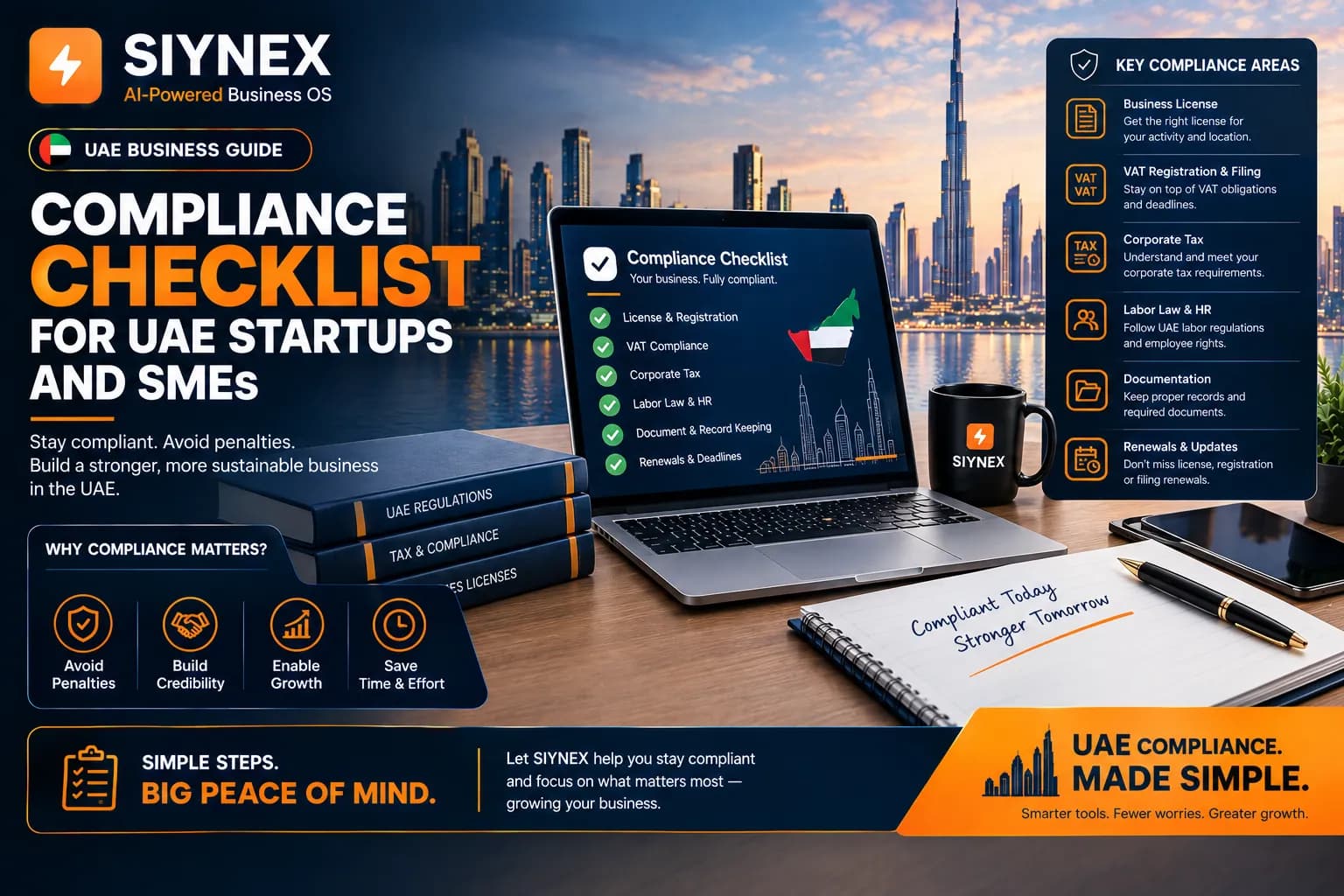
This checklist covers every major compliance area a UAE startup or SME must address in 2026. It is not a legal opinion. It is a structured audit tool — a starting point for identifying where your business is protected and where it is exposed. Work through it systematically. The categories that have gaps are the ones that need attention this week, not next quarter.
How to Use This Checklist
Each compliance category below includes:
- What the requirement is
- Why it matters (the risk if you do not comply)
- The specific items to check in your business
- A status column so you can mark each item: ✅ Done / ⚠️ Partial / ❌ Not in place
This is designed to be printed or saved and worked through as a team exercise. Involve your operations lead, finance manager, and HR lead — compliance gaps are almost always the result of nobody owning the responsibility.
Category 1: Business Licensing and Registration
Why it matters: Operating without a valid trade licence in the UAE is a criminal offence. An expired licence affects your ability to renew visas, open bank accounts, sign contracts, and access government services. It also voids your insurance and creates personal liability for directors.
Check these:
- [ ] Trade licence is valid and has not expired — check the expiry date today
- [ ] Trade licence activities accurately reflect what your business actually does (businesses frequently expand their activities without updating the licence)
- [ ] Memorandum and Articles of Association (MOA/AOA) are up to date and reflect current shareholders, directors, and share structure
- [ ] Registered address on trade licence matches your actual operational address — or a registered agent arrangement is documented
- [ ] All shareholders and directors hold valid UAE residency visas or have compliant arrangements for non-resident ownership
- [ ] Corporate bank account is active and linked to the registered entity — not a personal account
- [ ] If operating in a free zone: free zone licence is current, activities are within permitted scope, and any mainland operations are conducted through a properly licensed entity
- [ ] If operating in a mainland: local service agent agreement (if applicable to your legal structure) is current
Common gap: Businesses that started with one activity on their licence and gradually expanded into adjacent services without formally updating the licence. This creates potential penalties on inspection and voids the licence's protection for unlisted activities.
Category 2: VAT Registration and Filing
Why it matters: Federal Decree-Law No. 8 of 2017 on VAT imposes mandatory registration on any UAE business whose taxable supplies exceed AED 375,000 annually. Failing to register when required carries penalties of AED 20,000. Failing to file on time, filing incorrectly, or issuing non-compliant invoices carries additional penalties — up to AED 5,000 per invoice for non-compliant tax invoices.
Check these:
- [ ] Taxable supplies in the last 12 months have been assessed — are they above AED 375,000?
- [ ] If above AED 375,000: VAT registration is in place and the TRN is valid on the EmaraTax portal
- [ ] If between AED 187,500 and AED 375,000: voluntary registration decision has been made and documented
- [ ] If below AED 187,500: confirmed in writing that registration is not yet required — and this is being monitored as revenue grows
- [ ] All tax invoices issued include the 19 mandatory FTA fields (including TRN, "Tax Invoice" label, sequential numbering, VAT amount in AED, date of supply)
- [ ] VAT returns are filed quarterly (or on the schedule set at registration) by the deadline — typically the 28th of the month following the tax period
- [ ] Input VAT claims are supported by compliant tax invoices from VAT-registered suppliers — not proformas or quotations
- [ ] Zero-rated supplies are correctly classified and documented — export evidence retained
- [ ] Exempt supplies are correctly classified and not incorrectly showing VAT
- [ ] VAT records (invoices, returns, supporting documents) are retained and accessible for the FTA's minimum 5-year period
- [ ] A process exists for the e-invoicing mandate — software and workflow are being assessed ahead of phased rollout
Common gap: Businesses that are close to the AED 375,000 threshold but have never formally calculated their taxable supplies to confirm whether registration is required. Revenue figures on a profit and loss statement are not the same as taxable supplies for VAT purposes — some supplies may be exempt or zero-rated.
Category 3: Corporate Tax Compliance
Why it matters: UAE Corporate Tax (CT), introduced under Federal Decree-Law No. 47 of 2022, applies to the taxable income of UAE businesses at a rate of 9% on income above AED 375,000. It has been in effect since June 2023 for most businesses. Non-registration, late filing, and failure to maintain required documentation each carry significant penalties.
Check these:
- [ ] Corporate Tax registration is completed on the EmaraTax portal — all UAE businesses are required to register, including those whose taxable income is below the AED 375,000 threshold (threshold determines rate, not registration obligation)
- [ ] The entity's first CT tax period has been identified and the filing deadline has been calendared (12 months after the end of the first tax period, plus 9 months for filing)
- [ ] Taxable income has been assessed — is the business above or below the AED 375,000 threshold for the 9% rate?
- [ ] Qualifying Free Zone Person (QFZP) status has been assessed if operating in a UAE free zone — specific conditions apply to benefit from the 0% rate on qualifying income
- [ ] Transfer pricing rules have been considered if the business has related-party transactions — formal documentation may be required above certain thresholds
- [ ] Financial statements are being prepared on an accruals basis in accordance with IFRS (or IFRS for SMEs) — CT requires compliant financial statements
- [ ] Exempt income has been correctly classified (dividends from UAE subsidiaries, qualifying capital gains — specific conditions apply)
- [ ] Small Business Relief (SBR) eligibility has been assessed — businesses with revenue below AED 3 million may elect SBR for tax periods ending on or before 31 December 2026
- [ ] A tax agent or internal resource is responsible for CT compliance — the obligation does not self-execute
Common gap: Businesses that registered for VAT when it was introduced in 2018 but have not yet registered for Corporate Tax, assuming the process is optional or will be triggered automatically. It is not — CT registration is a separate, active requirement on EmaraTax.
Category 4: Employment Law Compliance
Why it matters: UAE Federal Decree-Law No. 33 of 2021 (UAE Labour Law), effective February 2022, significantly reformed employment protections, contract types, leave entitlements, probation rules, and termination procedures. Non-compliance exposes businesses to MoHRE complaints, labour court judgments, and reputational damage in a market where employer reputation affects visa processing and licence renewals.
Check these:
- [ ] All employees have written employment contracts that comply with the 2021 Labour Law — not contracts drafted under the superseded 1980 law
- [ ] Contracts clearly specify: job title, salary and allowances, work location, working hours, leave entitlement, probation period (maximum 6 months), notice period (minimum 30 days), and contract type (limited or unlimited term)
- [ ] New contract types introduced in 2022 are considered where relevant: part-time, temporary, flexible, and job-sharing contracts — remote workers and part-time staff require compliant contracts
- [ ] All employees are registered with the Ministry of Human Resources and Emiratisation (MoHRE) on the Tasheel system
- [ ] MOHRE-approved employment contracts are filed where required
- [ ] End-of-Service Gratuity (EOSB) is calculated correctly and accrued in accounts — or the business has registered with the DIFC Employee Workplace Savings (DEWS) scheme or equivalent alternative end-of-service scheme
- [ ] Annual leave entitlement is correctly applied: 30 calendar days per year after the first year of continuous service (2.5 days per month during year one)
- [ ] Sick leave entitlement is correctly applied: first 15 days at full pay, next 30 days at half pay, thereafter unpaid — within any 12-month period
- [ ] Maternity leave: 60 calendar days (45 days at full pay, 15 at half pay)
- [ ] Emiratisation (Nafis) obligations are assessed — businesses with 20 or more employees in the private sector have mandatory Emirati hiring quotas by sector; failure to meet targets incurs monthly penalties
- [ ] Wage Protection System (WPS): all employee salaries are paid through WPS-registered payroll — cash payments or transfers outside WPS are non-compliant
- [ ] Employee work permits and residency visas are valid and renewed before expiry
- [ ] A formal disciplinary and grievance procedure exists and is communicated to employees
Common gap: Businesses still operating on employment contracts drafted before February 2022 that reference superseded provisions — particularly around termination grounds, probation rules, and leave calculations. These contracts may not be void, but they create ambiguity in disputes that is resolved against the employer.
Category 5: Emiratisation (Nafis Programme)
Why it matters: The UAE's Emiratisation mandate — the Nafis programme — requires private sector businesses with 20 or more employees to hire Emirati nationals at minimum percentages by sector. Non-compliance carries a monthly penalty of AED 6,000 per unfilled Emirati position from January 2023, rising to AED 8,000 from January 2025 for businesses with 50 or more employees.
Check these:
- [ ] Total employee headcount has been assessed — is the business at or above the 20-employee threshold?
- [ ] If above 20 employees: the applicable Emiratisation quota for your sector has been confirmed on the Nafis portal
- [ ] Emirati employees are registered on the Nafis system and their employment is verified
- [ ] Monthly Emiratisation contribution (if quota is not met) is being paid correctly and on time
- [ ] Incentives available through the Nafis programme (salary support for Emirati hires in the private sector) have been assessed and claimed where eligible
- [ ] Any planned hiring considers Emiratisation targets proactively — last-minute compliance is significantly more costly than planned hiring
Common gap: Businesses that are close to 20 employees and have not anticipated the Emiratisation obligation as they grow. The threshold triggers a significant ongoing compliance burden that should be factored into hiring and financial planning before it is reached.
Category 6: Anti-Money Laundering (AML) and Know Your Customer (KYC)
Why it matters: UAE Federal Decree-Law No. 20 of 2018 on Anti-Money Laundering, Countering the Financing of Terrorism, and Illegal Organisations (AML/CFT law) applies to a wide range of UAE businesses — not just financial institutions. Designated Non-Financial Businesses and Professions (DNFBPs) including real estate agents, gold and precious metals dealers, lawyers, accountants, and company formation agents face mandatory AML registration, customer due diligence, and suspicious transaction reporting obligations.
Check these:
- [ ] Confirm whether your business is a DNFBP under UAE AML law — the definition covers more sectors than most businesses assume
- [ ] If DNFBP: registration on the goAML portal (operated by the UAE Financial Intelligence Unit) is completed
- [ ] AML/CFT Compliance Policy is in place and documented
- [ ] A Money Laundering Reporting Officer (MLRO) is designated — in smaller businesses, this is typically the owner or a senior manager
- [ ] Customer due diligence (CDD) procedures are in place for new clients — at minimum: identity verification, beneficial ownership confirmation, business purpose documentation
- [ ] Enhanced due diligence (EDD) procedures are applied for higher-risk clients: politically exposed persons (PEPs), clients from high-risk jurisdictions, complex ownership structures
- [ ] Suspicious Transaction Reports (STRs) are filed through the goAML portal when required
- [ ] AML training has been provided to relevant staff within the last 12 months
- [ ] Sanctions screening is conducted for new clients and counterparties against UAE and international sanctions lists (OFAC, UN, EU)
Common gap: Businesses in professional services — consultancies, freelancers providing company formation advice, accountants — that are technically DNFBPs but have never registered on goAML because they assumed AML obligations applied only to banks and financial companies.
Category 7: Personal Data Protection Compliance
Why it matters: UAE Federal Decree-Law No. 45 of 2021 — the Personal Data Protection Law (PDPL) — came into force in January 2022, with enforcement ramped up through 2023 and 2024. It applies to any UAE business that processes personal data of UAE residents, regardless of whether processing occurs inside or outside the UAE. Violations carry penalties of up to AED 5 million per violation.
Check these:
- [ ] A Privacy Policy is in place and publicly accessible on your website — it must explain what data is collected, why, how it is used, who it is shared with, and how individuals can exercise their rights
- [ ] Consent mechanisms are in place for marketing communications — opt-in consent is required, not just opt-out
- [ ] A data inventory (Record of Processing Activities) exists — what personal data do you hold, from whom, for what purpose, and where is it stored?
- [ ] Third-party data processors (cloud providers, CRM platforms, email marketing tools) have Data Processing Agreements (DPAs) in place
- [ ] Cross-border data transfers are assessed — if personal data of UAE residents is transferred outside the UAE, an adequacy assessment or safeguards are required
- [ ] A Data Breach Response procedure exists — the TDRA requires notification of certain data breaches within 72 hours of becoming aware
- [ ] Data Subject Access Requests (DSARs) can be processed — individuals have the right to access, correct, and request deletion of their personal data; you must have a mechanism to respond within the legally required timeframe
- [ ] Employee data is handled compliantly — employee personal data has specific protections under UAE law
- [ ] If your business operates a website with cookies, a Cookie Policy and consent banner are in place
Common gap: Businesses that have a generic privacy policy copied from a UK or US website referencing GDPR — which does not fulfil UAE PDPL requirements. The UAE PDPL has specific provisions that differ from GDPR; a GDPR-based policy is not a compliant substitute.
Category 8: Financial Records and Accounting
Why it matters: UAE Corporate Tax law requires businesses to maintain financial records sufficient to support their CT return. The FTA's VAT framework requires records to support VAT returns. Failure to maintain adequate records carries penalties and puts the business in an indefensible position during any audit.
Check these:
- [ ] Financial statements are produced at least annually — ideally quarterly for management purposes
- [ ] Accounting is conducted on an accruals basis (required for CT purposes) not cash basis
- [ ] IFRS or IFRS for SMEs is applied as the accounting standard (required for CT)
- [ ] All revenue is recorded and traceable to issued invoices — no undocumented income
- [ ] All expenses are supported by compliant tax invoices or receipts with adequate documentation
- [ ] Bank reconciliations are performed monthly — cash balances in the accounting system match bank statements
- [ ] Accounts payable and receivable are tracked and aged — overdue receivables are flagged and followed up
- [ ] Fixed asset register is maintained if the business owns equipment, vehicles, or property
- [ ] All financial records are retained for a minimum of 5 years (VAT) and 7 years (CT) — whichever is longer
- [ ] Financial records are backed up securely — ideally to a cloud system with UAE-compliant data storage
- [ ] An external auditor or licensed accountant reviews annual accounts — required for CT filing and highly recommended for all businesses above AED 1 million in revenue
Common gap: Businesses using cash-basis bookkeeping (common in small businesses) that have not transitioned to accruals basis accounting now that Corporate Tax has been introduced. Cash-basis records will not support a CT return and may result in significant adjustments on audit.
Category 9: Commercial and Contract Compliance
Why it matters: Operating without proper commercial documentation is the most common cause of business disputes in the UAE. Clear contracts protect your revenue, define your obligations, and give you a strong position in any dispute. The absence of documentation almost always benefits the other party.
Check these:
- [ ] Standard Service Agreement or contract template is in use for all client engagements above AED 10,000 — not just a quotation
- [ ] All contracts specify: governing law (UAE mainland courts, DIFC, ADGM, or arbitration), dispute resolution mechanism, payment terms, late payment provisions, and IP ownership
- [ ] Non-Disclosure Agreements (NDAs) are signed before any confidential discussions — before meetings, not after
- [ ] Purchase Orders are issued for all significant procurement — you are not committing spend based on verbal agreements
- [ ] Delivery Notes or Service Completion Certificates are signed by clients before invoices are issued
- [ ] All contracts are reviewed by a UAE-registered legal advisor before use — templates from non-UAE sources are not sufficient
- [ ] Contract register exists — a log of all active contracts, their value, start dates, renewal dates, and termination notice periods
- [ ] Retention periods for executed contracts: minimum 5 years, 15 years for real estate
Common gap: Businesses that use quotations as their only commercial document — no formal service agreement, no delivery confirmation, no signed acceptance. When payment is disputed, the quotation is an offer with no confirmed acceptance, not a binding contract.
Category 10: Insurance
Why it matters: UAE law requires certain types of insurance for businesses. Beyond legal requirements, commercial insurance protects your business from risks that would otherwise create existential financial exposure — a professional liability claim, a workplace accident, a cyber incident.
Check these:
- [ ] Medical insurance for all employees: mandatory under UAE law in Dubai and Abu Dhabi — employers must provide health insurance to all employees including dependants in some emirates
- [ ] Workmen's Compensation Insurance: mandatory for businesses employing manual workers
- [ ] Professional Indemnity (PI) Insurance: mandatory for certain regulated professions (legal, medical, engineering, financial advisory) and strongly advisable for all professional service businesses
- [ ] Public Liability Insurance: covers third-party injury or property damage arising from your business activities — required for businesses with physical premises
- [ ] Cyber Insurance: assessed and implemented if your business processes significant volumes of customer data, operates critical digital infrastructure, or would suffer significant financial harm from a cyber incident
- [ ] Directors and Officers (D&O) Insurance: assessed for businesses with formal boards or external directors
- [ ] All insurance policies are reviewed annually — coverage limits, exclusions, and renewal dates are tracked
Common gap: Professional service businesses — IT consultants, marketing agencies, management consultants — operating without Professional Indemnity insurance because they assume their contracts protect them. A contractual limitation of liability clause is not the same as insurance and does not pay a claim if a client pursues one.
Category 11: Intellectual Property Protection
Why it matters: The UAE's intellectual property framework — Federal Law No. 11 of 2021 on Industrial Property Rights and Federal Decree-Law No. 38 of 2021 on Copyrights — provides strong protections for registered IP. However, those protections only exist once you have registered or formally documented your IP. Unregistered IP is significantly harder to protect and enforce.
Check these:
- [ ] Trademarks: your business name, logo, and key brand elements are registered with the UAE Ministry of Economy — or a trademark registration application is in progress
- [ ] If operating internationally: trademark registrations cover all markets where you operate or plan to operate (Gulf region, UK, EU, as applicable)
- [ ] Domain names: your primary domains are registered in the entity's name, not an individual employee or freelancer
- [ ] Software and technology: if your business has developed proprietary software, source code ownership is documented and employees or contractors who contributed have signed IP assignment agreements
- [ ] Creative works: copyright ownership of any creative output (design, content, code) produced by contractors is confirmed via written assignment in the engagement contract — copyright does not automatically transfer to the commissioner in the UAE
- [ ] Trade secrets and confidential business information: NDAs are signed with all employees, contractors, and external parties who have access to proprietary information
- [ ] Patents: if your business has invented a novel process, product, or technology, patent protection has been assessed with a UAE IP attorney
Common gap: Businesses that have a logo or brand designed by a freelancer with no written IP assignment agreement. In the UAE, copyright in creative work belongs to the creator by default — not the business that commissioned and paid for it — unless there is a written assignment. Your logo may legally belong to the freelancer who designed it.
Category 12: Regulatory and Sector-Specific Compliance
Why it matters: Beyond the general business compliance framework, specific sectors in the UAE carry their own regulatory requirements. Operating in a regulated sector without the required licences or approvals carries significant penalties — including criminal liability in some cases.
Check these for your sector:
Financial Services:
- [ ] Financial services activities require authorisation from the UAE Securities and Commodities Authority (SCA), the Central Bank of UAE, or the relevant free zone financial regulator (DFSA for DIFC, FSRA for ADGM) — confirm your activities are authorised or exempt
- [ ] If providing financial advice, asset management, or payment services: regulatory capital requirements are met
Healthcare:
- [ ] Healthcare facilities and practitioners are licensed by the relevant health authority: Dubai Health Authority (DHA), Abu Dhabi Department of Health (DOH), or Ministry of Health (MoH) for other emirates
- [ ] Medical professionals hold valid licences issued by the relevant authority — licences must be renewed annually
Real Estate:
- [ ] Real estate brokers and agencies are registered with the Real Estate Regulatory Agency (RERA) in Dubai or equivalent authority in other emirates
- [ ] AML/CFT registration is in place on the goAML portal — real estate agents are DNFBPs
Food and Beverage:
- [ ] Food business licences from the relevant municipality (Dubai Municipality, Abu Dhabi Agriculture and Food Safety Authority, etc.) are current
- [ ] HACCP or equivalent food safety management system is implemented
Education:
- [ ] Private schools, training institutes, and nurseries are licensed by the Knowledge and Human Development Authority (KHDA) in Dubai or equivalent authority in other emirates
Technology and Data:
- [ ] If operating a social media platform or app collecting user data: UAE PDPL compliance is assessed against specific platform obligations
- [ ] If providing telecommunications services: TDRA authorisation requirements are assessed
General Check:
- [ ] All sector-specific licences and approvals are listed, with expiry dates tracked and renewal processes calendared at least 90 days before expiry
Your Complete UAE Compliance Status Summary
Use this summary table to capture your assessment across all twelve categories:
| # | Compliance Category | Status | Priority | Owner | Target Date |
|---|---|---|---|---|---|
| 1 | Business Licensing & Registration | ⬜ | |||
| 2 | VAT Registration & Filing | ⬜ | |||
| 3 | Corporate Tax Compliance | ⬜ | |||
| 4 | Employment Law Compliance | ⬜ | |||
| 5 | Emiratisation (Nafis) | ⬜ | |||
| 6 | AML & KYC | ⬜ | |||
| 7 | Personal Data Protection | ⬜ | |||
| 8 | Financial Records & Accounting | ⬜ | |||
| 9 | Commercial & Contract | ⬜ | |||
| 10 | Insurance | ⬜ | |||
| 11 | Intellectual Property | ⬜ | |||
| 12 | Sector-Specific Regulation | ⬜ |
How SIYNEX (BizMate AI) Supports UAE Compliance
Running a UAE business in 2026 means managing compliance obligations across twelve distinct categories — each with its own deadlines, documentation requirements, and penalty frameworks. Tracking this manually across spreadsheets, reminder emails, and ad-hoc conversations is not a system. It is a gap waiting to happen.
SIYNEX — the AI-powered Business Operating System built for UAE SMEs — centralises the operational and compliance infrastructure that growing businesses need:
FTA-Compliant Document Generation — Tax invoices, credit notes, and quotations are generated with all mandatory FTA fields pre-populated. Sequential numbering, TRN validation, VAT calculation, and AED conversion are handled automatically. E-invoicing readiness is built into the roadmap ahead of the mandate.
Contract and Document Management — Service agreements, NDAs, employment offer letters, and business proposals are generated from UAE-appropriate templates. Every document is stored, versioned, and searchable. Contract expiry dates trigger automated reminders before deadlines hit.
VAT and Corporate Tax Records — Every invoice created in SIYNEX feeds directly into your VAT summary and CT-ready financial records. Quarterly VAT return preparation becomes a reconciliation exercise rather than a data-gathering crisis.
Compliance Deadline Tracking — Trade licence renewal dates, VAT return deadlines, CT filing windows, visa expiry dates, and insurance renewals are tracked in one place. Automated alerts surface approaching deadlines before they become missed ones.
Employment Document Management — Employment contracts, offer letters, and visa tracking are managed within the platform. When Labour Law requirements change, template updates are pushed without requiring you to rebuild your document infrastructure.
Audit-Ready Records — Every transaction, document, and communication generated through SIYNEX is retained in its original format, accessible, and exportable. When an FTA audit or MoHRE inspection occurs, you produce your records in minutes, not days.
Compliance is not a project you complete once. It is an ongoing operational discipline. SIYNEX is built to make that discipline the default state of your business — not a periodic emergency.
See How SIYNEX Manages UAE Business Compliance →
Frequently Asked Questions
Q: Do all UAE businesses need to register for Corporate Tax, even if they are below the AED 375,000 threshold?
Yes. Corporate Tax registration on the EmaraTax portal is mandatory for all UAE businesses, regardless of whether their taxable income exceeds the AED 375,000 threshold. The threshold determines the applicable tax rate — businesses below it pay 0%, not nothing. Failure to register, even if no tax is owed, carries a penalty of AED 10,000.
Q: My business is in a free zone. Do UAE compliance requirements apply to me?
Most UAE compliance requirements apply to free zone entities. VAT, Corporate Tax registration, employment law, AML, and data protection obligations all apply to free zone businesses. The distinction is jurisdictional law for disputes (DIFC and ADGM operate under their own legal frameworks) and certain CT provisions (Qualifying Free Zone Persons may benefit from a 0% CT rate on qualifying income under specific conditions). Free zone status does not exempt a business from UAE federal compliance.
Q: How do I know if my business is a DNFBP and needs AML registration?
Designated Non-Financial Businesses and Professions include: real estate brokers and agents, dealers in precious metals and stones, auditors and accountants, lawyers and legal consultants, and company service providers (including business set-up consultants and registered agents). If your business falls into any of these categories, goAML registration and AML/CFT compliance obligations apply. If you are unsure, consult the UAE Ministry of Economy's DNFBP guidance or a UAE AML compliance consultant.
Q: What is the penalty for not registering for VAT when required?
The FTA penalty for failure to register for VAT when the registration threshold has been exceeded is AED 20,000. This is separate from ongoing penalties for non-compliant invoicing (AED 5,000 per invoice), late filing (AED 1,000 for the first month, AED 2,000 per subsequent month), and other VAT violations. The FTA has the authority to recover unpaid VAT from the date registration was required, plus interest.
Q: Is there a grace period for Corporate Tax compliance for new businesses?
The FTA has generally allowed some transition flexibility in the early phases of CT implementation, but formal grace periods are time-limited and specific conditions apply. Do not assume a grace period exists for your situation. New businesses should register for CT on EmaraTax as soon as they are established, and seek guidance from a UAE-registered tax agent on their first tax period and filing obligations.
Q: How often should I review this compliance checklist?
Conduct a full compliance review at least annually — ideally at the start of each financial year. Additionally, review whenever: your business changes activities or expands into new services, you cross a headcount or revenue threshold (20 employees for Emiratisation, AED 375,000 for VAT), a new law or regulatory update is announced, or you plan a significant transaction (acquisition, investment, restructuring).
Q: Can SIYNEX help me manage all of these compliance requirements?
SIYNEX centralises the operational and document management infrastructure that underpins most of these compliance categories — invoicing, contract management, financial records, deadline tracking, and employment documentation. For regulatory compliance decisions specific to your business (tax agent advice, legal counsel, AML consultant), SIYNEX connects you with the right UAE-registered professionals. No single platform replaces professional advice — but the right platform ensures your operational infrastructure supports compliance rather than working against it.
Summary
Twelve compliance categories. Hundreds of individual obligations. Evolving deadlines. Penalties that compound.
The businesses that manage UAE compliance well in 2026 are not the ones with the best intentions. They are the ones with the right systems — clear document infrastructure, tracked deadlines, accurate financial records, and operational processes that produce compliance as a by-product of how they work, not as a separate project they remember to run occasionally.
Work through this checklist. Mark every category honestly. Assign an owner to every gap. Set a resolution date. Then build the operational infrastructure that keeps you compliant without requiring a manual audit every six months.
SIYNEX is built to be that infrastructure for UAE SMEs — from your first tax invoice to your Corporate Tax filing, from your first employment contract to your contract register.
Start Your UAE Compliance Audit with SIYNEX →
Last updated: June 2026 | This checklist is for general informational purposes and reflects UAE federal and emirate-level regulations as of the publication date. Laws and regulations change — always verify current requirements with the relevant authority or a UAE-registered legal, tax, or compliance advisor. This checklist does not constitute legal or tax advice.
