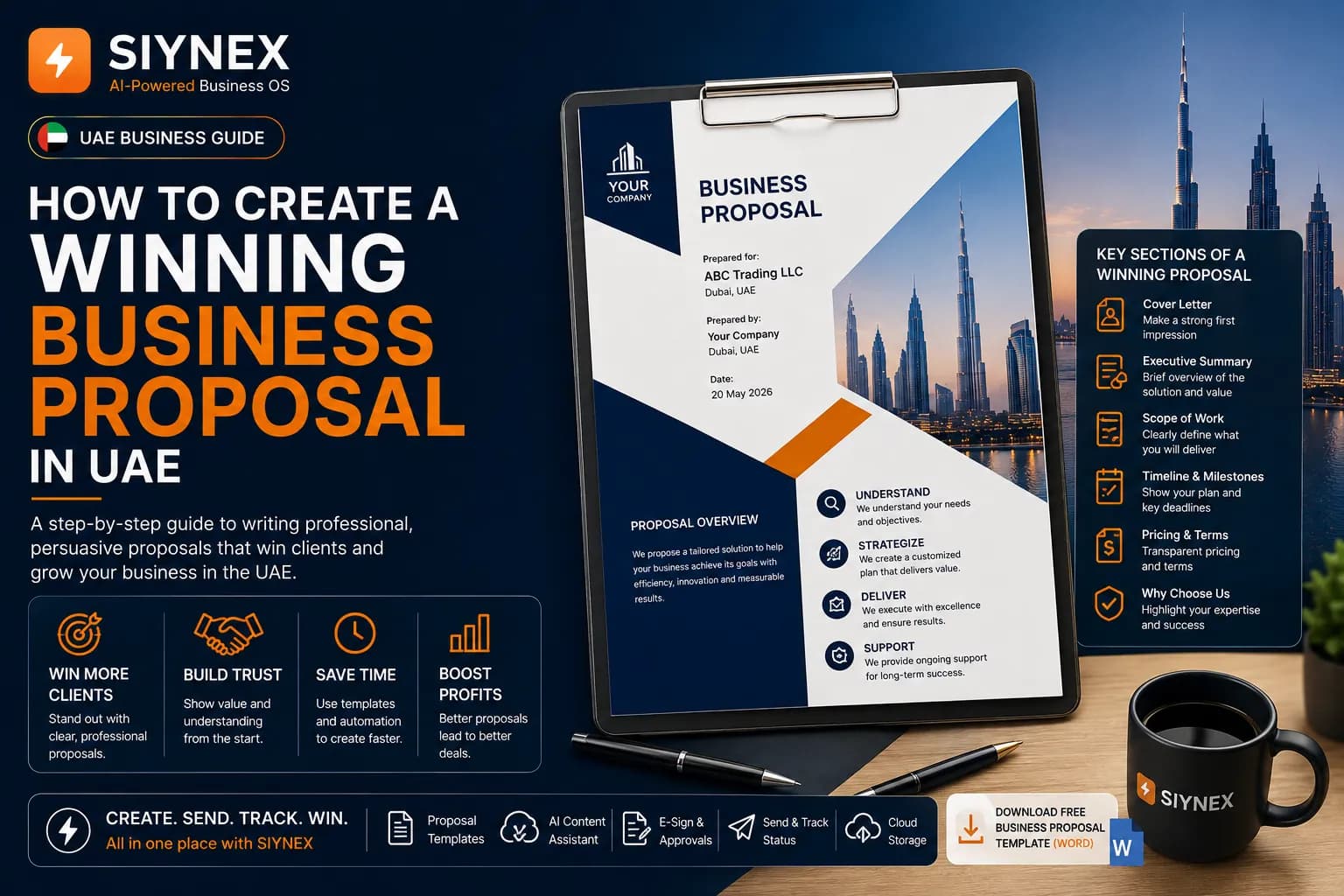
A strong business proposal helps a potential client understand three things quickly: the problem you understand, the result you can deliver, and why your business is a credible choice. It should make the commercial decision easier without forcing the reader to search through emails, presentations and separate pricing notes.
This guide explains how UAE freelancers, consultants, agencies and small businesses can prepare a clear proposal for a prospective client. Adapt every section to the opportunity, follow any instructions supplied by the client, and obtain professional advice when the proposal forms part of a regulated tender or legally binding agreement.
What Is a Business Proposal?
A business proposal presents a recommended solution to a specific client need. It normally explains the client's situation, the proposed scope, how the work will be delivered, the expected timeline, the price or commercial structure, and what should happen next.
A proposal is different from a general company profile. A company profile describes your business. A proposal explains how your business intends to solve this client's particular problem.
It is also different from a quotation. A proposal explains the solution and the reasoning behind it, while a quotation records the products, services, quantities, prices, validity and commercial terms. For a larger opportunity, the proposal and quotation can work together: the proposal explains the value and delivery approach, and the quotation provides the structured commercial offer.
If you need to prepare the supporting price document, see how SIYNEX helps businesses create and manage quotations.
Before You Start Writing
Do not begin with a generic template and immediately replace the client name. First collect the information that determines the proposal:
- The client's stated problem or objective
- The people affected by the problem
- The required outcome or deliverable
- The requested timeline
- Budget information, when available
- Procurement, submission or formatting instructions
- Evaluation criteria stated in an RFP or brief
- Questions that still need clarification
If the brief is incomplete, list your assumptions clearly. Hidden assumptions frequently become scope disputes later.
1. Write a Focused Executive Summary
The executive summary should help a decision-maker understand the proposal without reading every detail first. Keep it specific to the client.
Cover:
- The business problem or opportunity
- The outcome the client wants
- Your proposed response
- The main reason your approach is suitable
- The immediate next step
Avoid opening with a long history of your company. Start with the client's situation, then explain why your business is equipped to help.
2. Show That You Understand the Requirement
Restate the requirement in clear language. This gives the client an opportunity to confirm that both parties understand the same problem.
Include relevant context such as:
- Current process or difficulty
- Business impact
- Users, departments or locations involved
- Constraints already identified
- Required completion date
- Dependencies on the client or third parties
Do not invent facts. Mark estimates and assumptions as estimates and assumptions.
3. Define the Proposed Scope
Describe exactly what you will provide. Replace broad phrases such as “marketing support” or “software services” with concrete deliverables.
For each deliverable, consider stating:
- What will be delivered
- Quantity or coverage
- Format
- Responsible party
- Review or approval point
- Target completion date
Also state material exclusions. A clear out-of-scope section can prevent expectations from expanding after the proposal is accepted.
4. Explain Your Methodology
The methodology describes how the work will move from approval to completion. It gives the client confidence that the proposal is practical rather than aspirational.
A simple service methodology might include:
Use the stages that reflect your actual process. Do not promise approval, performance or results that depend on the client, a regulator or another third party.
5. Present a Realistic Timeline
Show the main stages, dates or durations. Make dependencies visible so the client understands what can affect delivery.
For example:
| Stage | Indicative timing | Dependency |
|---|---|---|
| Requirement confirmation | Week 1 | Client briefing and access |
| Initial delivery | Week 2 | Approved scope |
| Client review | Week 3 | Consolidated feedback |
| Final delivery | Week 4 | Approval of revisions |
6. Add Relevant Evidence
Evidence should support the client's decision. Select proof related to the proposed work rather than filling the document with unrelated achievements.
Useful evidence can include:
- Relevant projects or case studies
- Measurable outcomes you can substantiate
- Team experience
- Professional credentials
- Client references you are permitted to share
- Samples of comparable work
Never fabricate customers, results, testimonials or certifications. If information is confidential, describe it only at the level your agreement permits.
7. Make Pricing Easy to Understand
The pricing section should connect cost to scope. State whether the price is fixed, estimated, milestone-based, monthly or calculated by quantity.
Include, where applicable:
- Description of each priced item
- Quantity and unit price
- Subtotal
- Discount
- VAT treatment requiring confirmation
- Total
- Deposit or milestone schedule
- Payment terms
- Proposal or quotation validity
- Expenses or third-party costs
Use a separate quotation when the opportunity needs a structured commercial document. Review pricing, tax treatment and terms before sending it to the client.
8. State Responsibilities and Assumptions
Many delays occur because the proposal explains the supplier's work but not what the client must provide.
Clarify responsibilities such as:
- Supplying information or access
- Providing one authorized contact
- Reviewing work within an agreed period
- Consolidating feedback
- Approving milestones
- Obtaining internal or regulatory approvals
Record important assumptions alongside these responsibilities. If an assumption changes, both parties can identify whether the scope, timing or price needs review.
9. Finish With Clear Next Steps
Do not end the proposal with only “Thank you.” Tell the client what action moves the opportunity forward.
Possible next steps include:
- Confirm questions or requested revisions
- Accept the proposal or accompanying quotation
- Sign the applicable agreement
- Provide a purchase order
- Pay an agreed deposit
- Schedule a kickoff meeting
Include the proposal validity period and the correct contact for questions.
Common Proposal Mistakes
Reusing generic copy
A proposal that could be sent to any company does not demonstrate understanding of this client.
Hiding the scope in long paragraphs
Decision-makers should be able to identify deliverables, timing and pricing quickly.
Leaving assumptions unstated
Unstated assumptions become disagreements when delivery begins.
Promising outcomes outside your control
Do not guarantee regulatory approval, sales results, funding, tender awards or other third-party decisions.
Mixing proposal and quotation details inconsistently
If a separate quotation is attached, confirm that names, scope, dates, prices and terms agree across both documents.
Sending without a final review
Check client names, figures, dates, links, attachments, spelling and version numbers before sending.
Business Proposal Review Checklist
Before sending, confirm that the proposal:
- Addresses the client's actual requirement
- Uses the correct legal or trading names
- Defines deliverables and exclusions
- Explains the delivery approach
- Includes a realistic timeline
- States responsibilities and assumptions
- Presents pricing clearly
- Matches any accompanying quotation
- Avoids unsupported guarantees
- Includes a clear next step
- Has been reviewed for formatting and accuracy
Managing Proposals and Supporting Documents in SIYNEX
SIYNEX helps businesses prepare and review business documents from reusable templates. The completed wording, commercial terms and suitability remain the user's responsibility and should be reviewed before use.
Explore the SIYNEX Business Documents workflow, then use a connected quotation when the client needs structured pricing and commercial terms.
Frequently Asked Questions
What is the difference between a business proposal and a quotation?
A proposal explains the client's requirement, your recommended solution, delivery approach and supporting evidence. A quotation presents the structured commercial offer, including items, prices, validity and terms. Businesses often use both for larger opportunities.
How long should a business proposal be?
It should be long enough to support the decision and no longer. A straightforward service may need only a few focused pages, while a formal RFP response may require the structure and evidence specified by the buyer.
Should VAT appear in a proposal?
The commercial section should make the proposed tax treatment clear where relevant, but the correct treatment depends on the supplier, customer and transaction. Confirm the applicable treatment before sending the final quotation or invoice.
Does acceptance of a proposal replace a contract?
That depends on the proposal wording, acceptance process and transaction. A proposal is not a substitute for a formal agreement where one is required. Obtain qualified advice for material or legally sensitive engagements.
Can SIYNEX write and send the final proposal automatically?
SIYNEX supports template-based business document preparation. Users must review the generated document, confirm the wording and decide whether it is suitable before use.
Summary
A winning proposal is clear, specific and easy to evaluate. It shows that you understand the client, defines what you will deliver, explains how the work will proceed, presents pricing transparently and makes the next decision simple.
Use the proposal to explain the solution. Use the quotation to record the commercial offer. Review both documents together before sending them to the client.