Introduction
When the UAE announced Corporate Tax in 2022, the reaction from many small business owners was the same: "That's for big companies. It probably does not apply to me."
Four years later, that assumption is still costing businesses money — not in unpaid tax, but in missed registration deadlines, unfiled returns, and penalties for administrative non-compliance. Because here is what the UAE's Corporate Tax framework actually says: every UAE business must register, regardless of size, regardless of profit, and regardless of whether they owe a single dirham.
The good news for small businesses is real. The UAE's 9% Corporate Tax rate only applies to taxable income above AED 375,000. Below that threshold, the rate is 0%. Small Business Relief (SBR) offers an even simpler route for eligible businesses with revenue below AED 3 million. And if you understand the framework properly, there are legal and straightforward ways to manage your CT position without complicated tax planning.
The bad news is also real. The Federal Tax Authority is not waiting for businesses to catch up. Non-registration penalties, late filing penalties, and record-keeping failures are already being assessed. The UAE's EmaraTax portal is active, enforcement is ramping up, and the businesses that have treated Corporate Tax as something to deal with "eventually" are discovering that the cost of delay is accumulating quietly.
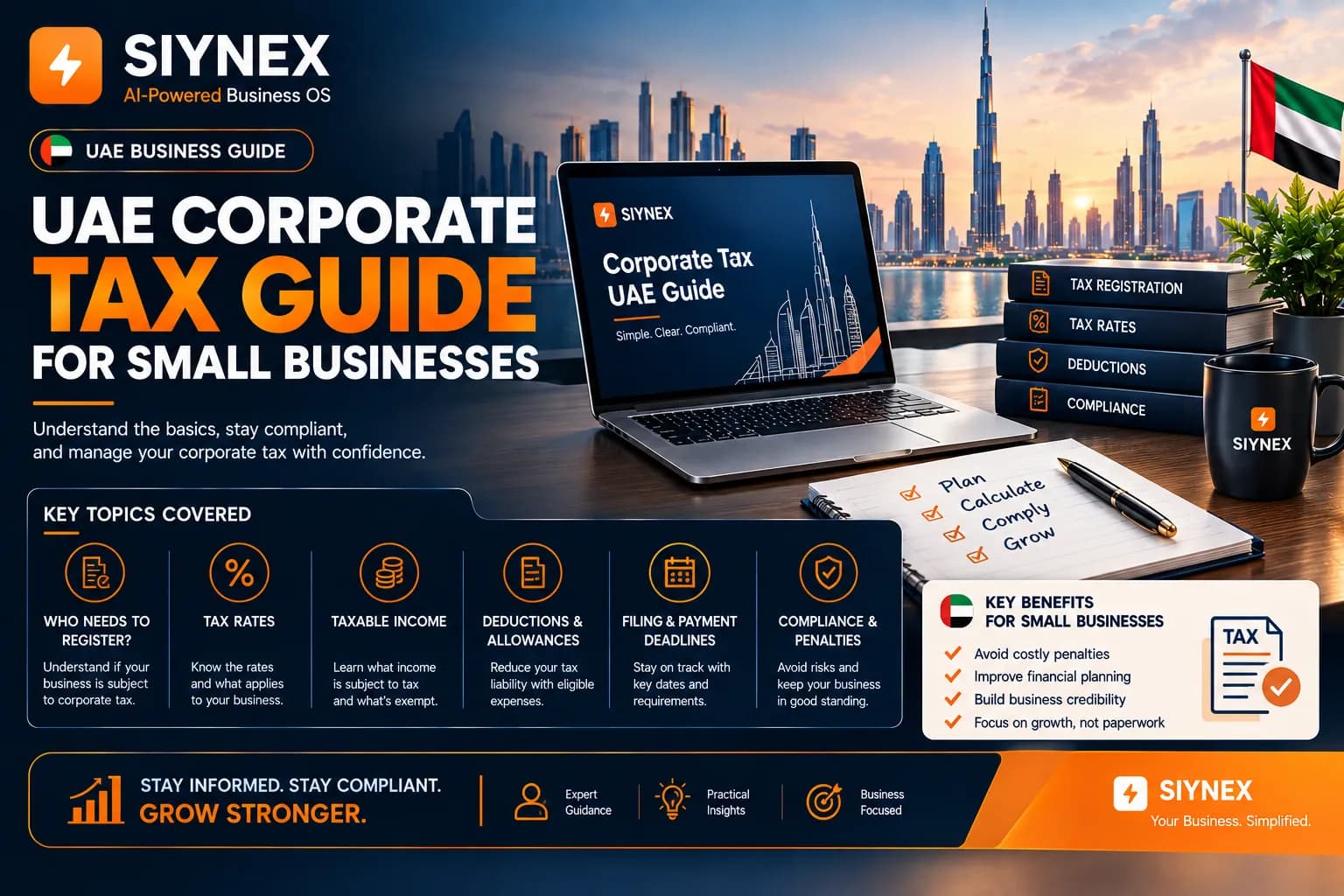
This guide explains everything a UAE small business needs to know about Corporate Tax in 2026: who it applies to, what rates apply, how to register, how to calculate taxable income, what reliefs are available, how to file your return, and what SIYNEX does to make the whole process manageable without a full-time tax team.
What Is UAE Corporate Tax?
UAE Corporate Tax (CT) was introduced under Federal Decree-Law No. 47 of 2022 on the Taxation of Corporations and Businesses. It is a federal tax on the net income — or taxable income — of businesses operating in the UAE.
Corporate Tax became effective for financial years beginning on or after 1 June 2023. For a business with a calendar year financial period (January to December), the first CT-liable financial year was January 2024 — with the return due 9 months after the end of that period, i.e., by 30 September 2025.
Before 2023, the UAE had no federal corporate income tax for most businesses (with the exception of certain oil and gas companies and foreign banks). The introduction of CT brought the UAE into line with international standards and the OECD's global minimum tax framework.
The key rates:
- 0% on taxable income up to AED 375,000
- 9% on taxable income above AED 375,000
- 15% (Pillar Two Qualifying Domestic Minimum Top-up Tax) for large multinational enterprises with consolidated global revenues exceeding EUR 750 million — this does not apply to typical UAE SMEs
For the overwhelming majority of UAE small businesses — those with taxable income below AED 375,000 — the effective CT rate on their profit is zero. But the compliance obligations (registration, record-keeping, return filing) apply regardless of the amount owed.
Who Does UAE Corporate Tax Apply To?
This is the question most small business owners need to answer first.
Subject to Corporate Tax:
- UAE mainland companies and establishments (LLCs, sole establishments, civil companies)
- UAE free zone companies (subject to specific rules — see the free zone section below)
- Foreign companies with a permanent establishment in the UAE
- Foreign companies that derive UAE-sourced income
- Individuals conducting business in the UAE under a trade license — including freelancers and sole traders who operate through a licensed entity
Exempt from Corporate Tax:
- UAE federal and emirate-level government entities
- UAE government-controlled entities (specific conditions apply)
- Extractive businesses (oil and gas) subject to emirate-level taxation
- Qualifying public benefit entities (registered charities and non-profit bodies meeting specific conditions)
- Qualifying investment funds meeting prescribed conditions
- Pension and social security funds
Critical point for small businesses: The exemption list does not include small businesses simply because they are small. A sole establishment with annual revenue of AED 200,000 is subject to CT. An LLC with two partners and AED 150,000 in profit is subject to CT. Size does not determine applicability — only whether you fall into one of the specific exempt categories determines whether CT applies.
The AED 375,000 Threshold — What It Actually Means
The AED 375,000 threshold is probably the most misunderstood element of UAE Corporate Tax among small businesses. Here is exactly what it means and what it does not mean.
What it means: Taxable income up to AED 375,000 is taxed at 0%. Taxable income above AED 375,000 is taxed at 9% on the amount above the threshold only — not on the entire income.
Example: A business with AED 500,000 in taxable income pays 0% on the first AED 375,000 and 9% on the remaining AED 125,000. The CT liability is AED 11,250 — not 9% of AED 500,000 (which would be AED 45,000).
What it does not mean: The threshold is not a registration threshold. It is not an exemption threshold. A business with AED 100,000 in taxable income must still register for CT, must still file a CT return, and must still maintain CT-compliant financial records — they simply owe AED 0 in tax.
Taxable income vs. revenue: The threshold applies to taxable income — your net profit after allowable deductions — not to your gross revenue or turnover. A business with AED 1 million in revenue but AED 300,000 in allowable expenses has taxable income of AED 700,000. The threshold calculation applies to the AED 700,000, not the AED 1 million.
The distinction between revenue and taxable income is where most small business calculations go wrong. Do not apply the threshold to your revenue figure and assume you know your CT position. Calculate your taxable income properly.
Small Business Relief (SBR) — The Simplified Option for Small UAE Businesses
Small Business Relief is arguably the most important CT provision for UAE SMEs — and the most under-utilised.
What is SBR?
Under Ministerial Decision No. 73 of 2023, eligible businesses can elect to be treated as having zero taxable income for a CT tax period — meaning no CT is owed and simplified compliance obligations apply. This is not an exemption from CT — it is a relief election that simplifies the compliance burden for qualifying small businesses.
Who qualifies for SBR?
A UAE business qualifies for Small Business Relief in a tax period if:
- It is a UAE resident person (UAE-incorporated entity or individual with UAE trade license)
- Its revenue in the tax period does not exceed AED 3 million
- Its revenue in all previous tax periods since 1 June 2023 has also not exceeded AED 3 million
- It is not a member of a Multinational Enterprise (MNE) group
- It has not elected to be a Qualifying Free Zone Person (QFZP)
What does SBR mean in practice?
A business that elects SBR for a tax period is treated as having zero taxable income for that period. This means:
- CT liability is AED 0 for that period
- Simplified record-keeping requirements apply
- The business still needs to register for CT and file a CT return
- The SBR election must be made in the CT return for the relevant period
The AED 3 million revenue cap is per tax period. If your revenue exceeds AED 3 million in any period, you lose eligibility for SBR in that period and in all future periods — even if revenue falls below AED 3 million again.
Who should consider SBR: Any UAE business with annual revenue below AED 3 million should assess SBR eligibility before preparing a standard CT return. For many small businesses — freelancers, consultants, small trading companies, service businesses — SBR eliminates the CT liability and simplifies the compliance process significantly.
Who should be cautious about SBR: Businesses planning to grow above AED 3 million revenue in the near term, businesses with significant deductible expenses that would reduce taxable income well below the AED 375,000 threshold anyway, and businesses where the SBR election might conflict with other tax planning.
UAE Free Zone Businesses and Corporate Tax
Free zone businesses occupy a specific position in the UAE CT framework that confuses many business owners. Here is the clear version.
All free zone entities are subject to UAE Corporate Tax. Being in a free zone does not exempt a business from CT.
However, Qualifying Free Zone Persons (QFZPs) benefit from a 0% CT rate on Qualifying Income. A QFZP is a free zone entity that meets all of the following conditions:
- Maintains adequate substance in the UAE (real economic activity, appropriate staff, assets, and operating expenditure)
- Derives Qualifying Income (specific categories of income from qualifying activities and from transactions with other free zone persons or non-UAE customers)
- Does not elect to be subject to the standard CT regime
- Complies with transfer pricing rules
- Maintains audited financial statements
- Does not derive income from excluded activities above a de minimis threshold (5% of total revenue or AED 5 million, whichever is lower)
Qualifying Income includes: income from transactions with other QFZPs, income from qualifying activities conducted with non-free-zone persons (subject to conditions), and specific categories such as fund management, treasury services, and distribution from a qualifying distribution centre.
Non-Qualifying Income — income that does not meet the QFZP conditions — is taxed at 9% on the portion above AED 375,000.
The practical reality for small free zone businesses: Many small free zone businesses — particularly those with significant revenue from UAE mainland customers — will find that a substantial portion of their income is Non-Qualifying Income. This means they are not fully exempt from the 9% rate even if they are technically a QFZP. The QFZP assessment requires careful analysis of your specific income sources and activities.
If you operate in a free zone and have not had your QFZP eligibility formally assessed by a UAE-registered tax agent, this should be your next step.
How to Register for UAE Corporate Tax
Registration is mandatory for all UAE businesses — there is no opt-in or opt-out based on size or profit level.
Where to register: The FTA's EmaraTax portal at tax.gov.ae
Who registers: Every UAE business entity — mainland LLC, sole establishment, free zone company, branch of a foreign company — must register separately. Group registration is available for connected groups meeting specific conditions.
When to register: The FTA has issued deadlines for CT registration based on when a business was incorporated and when its first tax period begins. For businesses that were already established before June 2023, registration deadlines have been staggered. Check the FTA's published registration deadline guidance on EmaraTax for your specific situation.
What you need to register:
- Your UAE trade license number and details
- Entity type and legal structure
- Shareholder and director details
- Financial year end (your tax period end date)
- Business activities description
- Estimated annual revenue
- Your UAE VAT TRN (if registered for VAT)
Penalty for late registration: AED 10,000 fixed penalty for failure to register on time. This applies regardless of whether the business owes any tax. The penalty is not waived because of small business size or zero taxable income.
The registration process itself is straightforward and digital. Most businesses can complete it in under an hour through the EmaraTax portal. The obstacle is not complexity — it is that many businesses have simply not done it.
What Counts as Taxable Income for UAE SMEs?
Taxable income for UAE CT purposes is the accounting net profit of the business, adjusted for specific CT rules. Understanding the adjustments is where small businesses often need guidance.
Starting point: accounting profit
Take your net profit as shown in your financial statements prepared under IFRS or IFRS for SMEs. This is the baseline.
Add back (increases taxable income):
- Expenses that are not deductible for CT purposes: fines and penalties paid to government authorities, entertainment expenses above 50% of the amount, personal expenses charged through the business
- Dividends and profit distributions to shareholders (these are not expenses — confirm they have not been treated as such)
- Depreciation on non-qualifying assets
- Provisions that do not meet the CT recognition criteria
Deduct (reduces taxable income):
- All ordinary business expenses that are wholly and exclusively incurred for the purpose of generating taxable income
- Depreciation on qualifying assets in accordance with CT rules
- Qualifying interest expense (subject to a 30% EBITDA limitation for larger businesses — typically less relevant for small businesses below the threshold)
- Losses from prior periods carried forward (subject to conditions and a 75% utilisation cap per period)
Key deductible expenses for UAE small businesses:
- Employee salaries, benefits, and end-of-service gratuity accruals
- Rent and premises costs
- Professional fees (accounting, legal, consulting)
- Technology and software subscriptions
- Marketing and advertising
- Bank charges and financial costs (within limits)
- Depreciation on business equipment and assets
Non-deductible expenses small businesses commonly get wrong:
- Owner/director drawings or personal expenses run through the business — not deductible
- Expenses without supporting documentation (no invoice, no receipt) — not deductible
- Fines, penalties, and late payment charges — not deductible
- 50% of entertainment, hospitality, and similar expenses — only 50% is deductible
How to File a UAE Corporate Tax Return
The CT return is filed annually through the EmaraTax portal. Here is the process for small businesses.
Step 1 — Prepare your financial statements
Your CT return is based on IFRS-compliant (or IFRS for SMEs) financial statements for your tax period. If you do not already produce formal financial statements, you need to start — a standard profit and loss account and balance sheet is the minimum.
For businesses electing Small Business Relief, the financial statement requirement is simplified — revenue confirmation is the primary requirement.
Step 2 — Calculate your taxable income
Adjust your accounting profit for the CT-specific additions and deductions described above. For businesses below the AED 375,000 taxable income threshold, document your calculation clearly — this is your evidence that no tax is owed.
Step 3 — Determine your elections
Decide whether to elect Small Business Relief (if eligible). Make any other elections available under the CT law — such as realisation basis for capital gains (allows you to defer recognition of gains until assets are actually sold rather than when their value changes).
Step 4 — File the CT return on EmaraTax
Log in to EmaraTax (tax.gov.ae), navigate to Corporate Tax, and complete the CT return for your tax period. The return captures your entity details, revenue, taxable income, reliefs elected, and CT liability.
Step 5 — Pay any CT due
If your CT return shows a liability, payment is due by the filing deadline. Payment is made through EmaraTax. Businesses with no liability (below AED 375,000 threshold or SBR elected) file a nil return — still mandatory.
Filing deadline: 9 months after the end of the relevant tax period. For a business with a 31 December year end, the first CT return covering the 2024 calendar year is due by 30 September 2025. For a business with a 31 May year end, the return for the period ending 31 May 2024 is due by 28 February 2025.
Penalties for late filing:
- AED 500 per month for the first 12 months of delay
- AED 1,000 per month from month 13 onwards
- Additional penalties for understated CT liability (ranging from 50% to 400% of the underpaid tax depending on the nature and severity of the error)
Record-Keeping Requirements for UAE Corporate Tax
The FTA requires CT-registered businesses to maintain financial records and supporting documents for 7 years from the end of the relevant tax period.
What must be maintained:
- IFRS-compliant financial statements (income statement, balance sheet, cash flow statement, notes)
- General ledger and accounting records
- All invoices, receipts, and supporting documents for income and expenses
- Bank statements reconciled to the accounting records
- Asset registers for fixed assets
- Payroll records
- Transfer pricing documentation (for related-party transactions above the materiality threshold)
- Any correspondence with the FTA
Penalty for inadequate record-keeping: AED 10,000 for the first instance, AED 50,000 for repeat violations within a two-year period.
For small businesses using SBR: Simplified record-keeping applies — revenue records and supporting documentation confirming eligibility for SBR are the minimum requirement. However, maintaining complete financial records remains best practice even under SBR, since eligibility in a future period may require demonstrating historical revenue figures.
UAE Corporate Tax and VAT — How They Interact
CT and VAT are separate taxes with separate registration, filing, and payment obligations. However, they interact in important ways for UAE businesses.
VAT input tax is not a CT deduction. VAT charged by your suppliers that you reclaim as input VAT is not your expense — it is a pass-through. Your CT deductible expenses are the amounts exclusive of recoverable VAT.
VAT output tax is not your income. VAT you charge to customers on your invoices is collected on behalf of the FTA — it is not your revenue. Your CT taxable income is based on your net revenue exclusive of VAT.
The AED 375,000 thresholds are unrelated. The AED 375,000 VAT registration threshold (applied to taxable supplies) and the AED 375,000 CT threshold (applied to taxable income) are entirely separate calculations. A business can be VAT-registered with CT taxable income below AED 375,000, or not VAT-registered with CT taxable income above AED 375,000.
VAT-compliant invoicing supports CT records. Your UAE tax invoices — which must already comply with FTA VAT requirements — form part of your CT documentation. A business with well-maintained VAT records has a significant head start on CT record-keeping.
Common Corporate Tax Mistakes UAE Small Businesses Make
Not registering because "the amount is too small to matter"
Every UAE business must register. The penalty for not registering is AED 10,000 regardless of taxable income. There is no de minimis exemption from the registration obligation.
Confusing revenue with taxable income
Many small businesses apply the AED 375,000 threshold to their revenue and conclude they owe nothing — without performing the actual taxable income calculation. Revenue and taxable income are different numbers. Taxable income is revenue minus allowable deductions. Know your actual number.
Not assessing SBR eligibility
Thousands of UAE small businesses with revenue below AED 3 million are preparing full CT calculations when they could simply elect Small Business Relief. If your revenue is below AED 3 million and you have not yet assessed SBR, do it now — you may be making the process significantly harder than it needs to be.
Running personal expenses through the business
Owner drawings, personal travel, personal purchases — these are common in small UAE businesses and are commonly coded as business expenses in the accounts. For CT purposes, personal expenses are non-deductible. Running them through the business does not make them a tax deduction. It creates a record-keeping problem and a CT adjustment.
Missing the filing deadline because "there's nothing to pay"
A nil CT return must still be filed by the deadline. The AED 500 per month late filing penalty applies whether or not you owe any tax. Many small business owners miss the deadline precisely because they assume a zero-liability position means no action is required.
Not maintaining IFRS-compliant financial statements
The CT framework requires financial statements prepared under IFRS or IFRS for SMEs. Cash-basis records, a simple spreadsheet of income and expenditure, or a bank statement are not sufficient. If your business has not been producing formal financial statements, this is the most urgent gap to address.
Overlooking related-party transactions
If your business transacts with related parties — another company owned by the same shareholder, loans from shareholders, services charged to or from a connected entity — transfer pricing rules may apply. These transactions must be conducted at arm's length and documented. Small businesses often overlook this because they assume transfer pricing is only for multinationals.
How SIYNEX Supports UAE Corporate Tax Compliance
For most UAE small businesses, the biggest CT challenge is not the tax itself — it is the compliance infrastructure. IFRS financial statements, 7-year record retention, EmaraTax filing, and coordinated VAT-CT record management are burdens that grow disproportionately large for businesses without a finance team.
SIYNEX — the AI-powered Business Operating System for UAE SMEs — provides that infrastructure without requiring you to build a finance department.
IFRS-Ready Financial Records
Every invoice, expense, and transaction recorded in SIYNEX feeds into CT-ready financial records. Your income statement and supporting documentation are maintained in IFRS-compatible format from day one — not reconstructed at year-end from a shoebox of receipts.
VAT-CT Integration
Your SIYNEX tax invoices feed directly into both your VAT return data and your CT income records. No duplication, no manual reconciliation between systems. The records that support your VAT position also support your CT position — maintained automatically.
CT Deadline Tracking
Your Corporate Tax registration deadline, filing deadline, and payment deadline are tracked in SIYNEX's compliance calendar. Automated reminders escalate as deadlines approach. You are alerted at 90 days, 60 days, and 30 days before each CT deadline — not 5 days, when it is too late to get organised.
SBR Eligibility Monitoring
SIYNEX tracks your cumulative revenue against the AED 3 million SBR threshold in real time. When your revenue approaches the threshold, you are alerted — giving you time to plan, rather than discovering you have crossed it after the fact.
Document Retention and Audit Readiness
Every financial document in SIYNEX is retained for the FTA's required periods. When the FTA requests records for an audit or enquiry, you export from SIYNEX — a complete, organised, dated record set — rather than assembling documents from multiple systems, inboxes, and filing cabinets.
Professional Referral for Complex Situations
For CT positions requiring professional advice — QFZP eligibility, related-party transactions, transfer pricing documentation, loss carry-forward optimisation — SIYNEX connects you with UAE-registered tax agents and accountants. The platform handles the operational layer; the professionals handle the advisory layer.
See How SIYNEX Manages Your UAE Corporate Tax Compliance →
Frequently Asked Questions
Q: My business made a loss this year. Do I still need to file a UAE Corporate Tax return?
Yes. Every CT-registered business must file a CT return for each tax period, regardless of whether a profit or loss was made. A loss-making business files a nil return or a return showing a loss position. Carry-forward of CT losses (to offset taxable income in future periods, subject to a 75% utilisation cap) requires them to be declared in the return — you cannot claim the loss carry-forward later if it was not declared in the year it arose.
Q: I am a freelancer with a UAE freelance permit. Does Corporate Tax apply to me?
If you conduct business in the UAE and hold a trade license or freelance permit, you are within the scope of UAE Corporate Tax. Freelancers operating through a licensed entity (even a freelance permit) must register for CT. However, if your revenue is below AED 3 million, Small Business Relief is likely available and would result in zero CT liability. Registration and filing are still required.
Q: My UAE business is owned by a foreign company. Does that change my CT position?
If your UAE entity is a subsidiary of a foreign company, transfer pricing rules apply to transactions between the entities (intercompany loans, management fees, royalties, services). These transactions must be conducted at arm's length and documented. The foreign parent's CT position in its own jurisdiction is separate from your UAE CT position, but the intercompany arrangements between them require careful attention.
Q: When is the first UAE Corporate Tax return due for a business with a December year end?
For a business with a December 31 year end, the first CT financial year is January 1 to December 31, 2024. The CT return for this period is due 9 months after December 31, 2024 — i.e., September 30, 2025. If this deadline has passed and you have not filed, late filing penalties are already accruing at AED 500 per month.
Q: Can I deduct my own salary as a UAE business owner?
This depends on your legal structure. For a UAE LLC, a salary paid to the owner-director through the payroll is generally deductible if it reflects an arm's-length rate for the services performed. Owner drawings — amounts taken out of the business that are not structured as a formal salary — are not deductible. For sole establishments and civil companies, the treatment of owner remuneration requires specific advice from a UAE tax agent.
Q: Is there a minimum tax for UAE businesses, even if taxable income is zero?
No. There is no minimum CT payment for UAE businesses. A business with zero taxable income (whether below the AED 375,000 threshold, electing SBR, or genuinely loss-making) owes AED 0 in Corporate Tax for that period. The obligations that apply regardless of tax position are: registration, annual return filing, and record-keeping.
Q: How does UAE Corporate Tax interact with my home country's tax system?
If you are an individual resident in a country that taxes its residents on worldwide income, your UAE business income may be subject to tax in your home country as well. UAE CT paid can often be credited against home country tax under double taxation agreements. The specific treatment depends on your home country's tax rules and any double taxation treaty between your country and the UAE. This is an area requiring personalised advice from a tax professional familiar with both jurisdictions.
Summary: UAE Corporate Tax — What Every Small Business Must Do Now
Corporate Tax is not a future obligation for UAE small businesses. It is a current one. The registration deadline has passed for many businesses. Filing deadlines for the first tax period are either passed or imminent. Penalties are accruing for businesses that have not acted.
Here is what you need to do:
If you have not registered: Register on EmaraTax (tax.gov.ae) immediately. Pay the AED 10,000 penalty if you are already late. The longer you wait, the larger the compounding risk.
If you are registered but have not filed: Prepare your first CT return. If your revenue is below AED 3 million, assess SBR eligibility first — you may be able to file a simplified return. Engage a UAE tax agent if your financial records are not IFRS-compliant.
If you are registered and have filed: Review your SBR eligibility for current and future periods. Confirm your record-keeping meets the 7-year FTA requirement. Set your next filing deadline in your compliance calendar.
If you are in a free zone: Have your QFZP eligibility formally assessed by a UAE tax agent. Do not assume your free zone status creates a CT exemption — it does not, and non-qualifying income is taxed at 9% above AED 375,000 regardless of where you are located.
UAE Corporate Tax is manageable. The framework is straightforward for most small businesses. The costs of non-compliance — registration penalties, filing penalties, interest on unpaid tax — are disproportionate to the cost of compliance. Act now.
Set Up Your UAE Corporate Tax Compliance in SIYNEX →
Last updated: June 2026 | This article reflects UAE Corporate Tax law under Federal Decree-Law No. 47 of 2022 and associated Ministerial Decisions as of the publication date. Tax law interpretation and FTA guidance evolve — always verify current requirements with the FTA's EmaraTax portal and consult a UAE-registered tax agent for advice specific to your business. This article does not constitute tax advice.