Introduction
Most UAE businesses know they need to keep VAT records. Far fewer know exactly which records, for how long, in what format — and what happens when the FTA asks for something they cannot produce.
The Federal Tax Authority does not announce audits far in advance. When a notice arrives, you typically have five business days to prepare. If your records are incomplete, disorganised, or stored in a format the FTA cannot accept, that is not just an inconvenience — it is a compliance failure, even if every single tax transaction was handled correctly.
For SMEs and freelancers in particular, record keeping is the compliance gap that causes the most avoidable penalties. The business owner who filed every VAT return on time but kept purchase receipts in a desk drawer, cannot remember which invoices were issued in Q3 2022, and never kept copies of contracts supporting their VAT treatment — that business is vulnerable the moment an FTA audit begins.
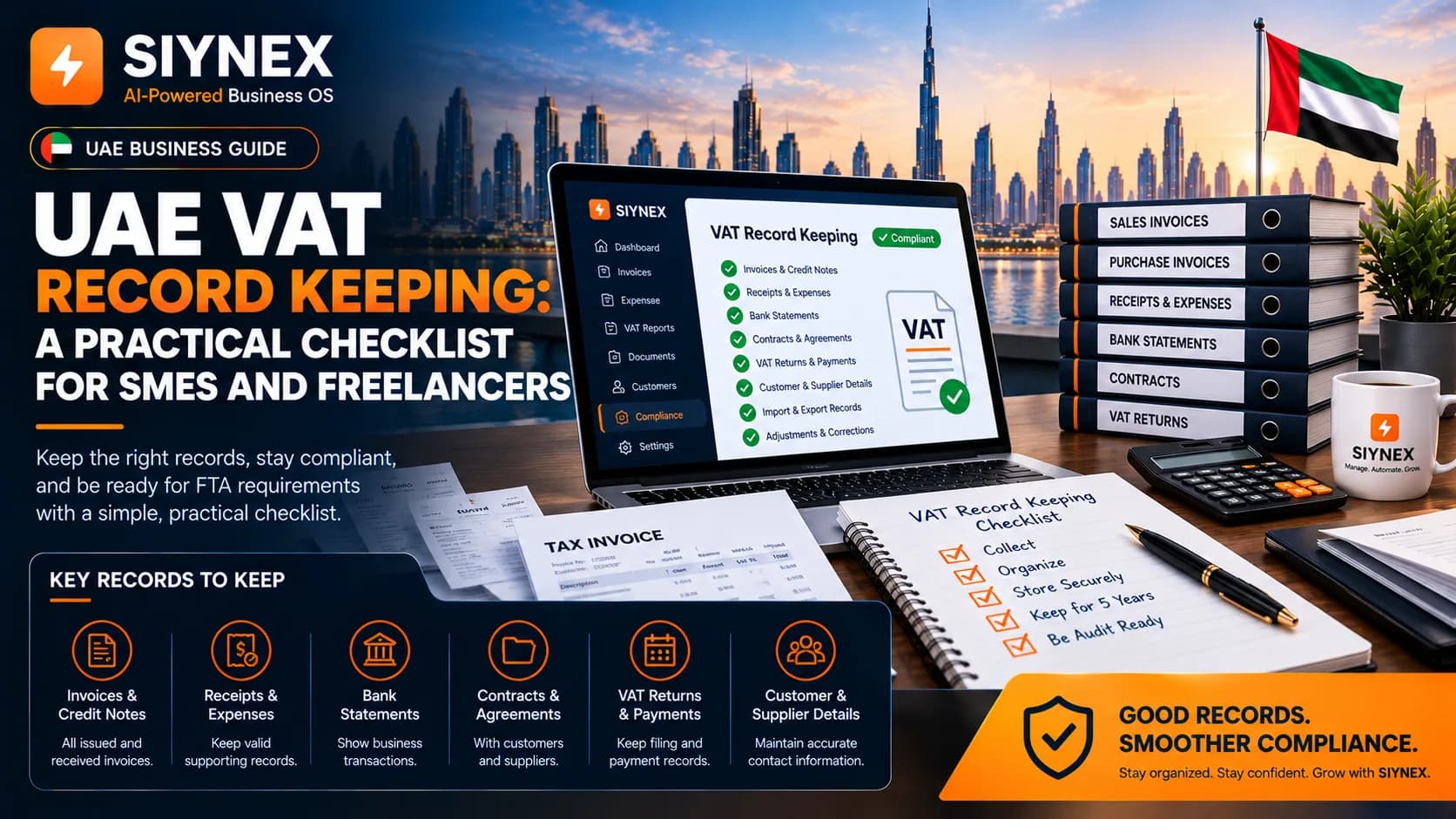
This article covers every record-keeping requirement under UAE VAT law, the retention periods that apply to each document type (including the longer periods that most businesses overlook), the 2026 penalty updates, what FTA auditors actually look for, and a practical checklist you can use to assess your current position.
The Legal Basis for UAE VAT Record Keeping
UAE VAT record-keeping obligations are grounded in three primary instruments:
Federal Decree-Law No. 8 of 2017 on Value Added Tax, Article 78
This is the core obligation. Every VAT-registered business must maintain records of all supplies made and received, imports, exports, and VAT adjustments. The standard retention period under this article is five years from the end of the relevant tax period, with a 15-year period for real estate transactions.
Federal Decree-Law No. 17 of 2025 on Tax Procedures (effective January 2026)
This law expanded the FTA's audit powers and tightened the penalty framework. It governs how audits are conducted, what the FTA can access, and what happens when records are not maintained properly.
Cabinet Decision No. 129 of 2025 (effective April 2026)
This Decision updated the administrative penalties for record-keeping failures, reducing one penalty (Arabic translation) and clarifying the repeat-offence window for the core record-keeping failure penalty. See the penalty section below for the specific amounts.
Cabinet Decision No. 17 of 2026 (effective April 2026)
Introduced an additional two-year retention requirement for businesses with pending VAT refund applications. If you have filed a timely refund claim that the FTA has not yet decided, you must keep the relevant records for two years beyond the standard five-year period.
Who Must Keep VAT Records — Including Those Who Might Assume They Are Exempt
VAT-registered businesses
Every business registered for UAE VAT has a full record-keeping obligation. This applies regardless of business size, legal structure, or turnover level above the registration threshold.
Businesses below the VAT threshold
If your annual revenue is below AED 375,000 and you have chosen not to register for VAT, you are not exempt from record-keeping entirely. Non-registered businesses may still need to keep records that demonstrate their non-taxable status — for example, evidence that revenue is genuinely below the registration threshold. If the FTA queries your non-registration, you need documentation to support the position.
Freelancers and sole proprietors
UAE bookkeeping and VAT obligations apply to every business entity, including freelancers and sole proprietors. There is no SME or freelancer exemption from record-keeping requirements. A freelancer who is VAT-registered (because their annual revenue exceeds AED 375,000) has exactly the same record-keeping obligations as a limited liability company of 50 people.
Deregistered businesses
Deregistration from VAT does not end your record-keeping obligation. Records must be maintained for the full statutory period from the date of the relevant transactions — not from the date of deregistration. A business that deregisters in 2024 must still be able to produce 2019 VAT records in 2024 if they fall within the five-year window.
Businesses that have ceased trading
Closing a trade licence does not end the duty to retain records. The appointed legal representative or the former owner must maintain records for the full statutory retention period even after business activities have stopped.
The Seven Categories of Records You Must Keep
Category 1: Tax Invoices — Issued and Received
Every tax invoice you issue to customers and every tax invoice you receive from suppliers must be retained.
For invoices you issue:
- The full tax invoice, including all 19 mandatory FTA fields (TRN, invoice number, date, description, quantity, unit price, subtotal, VAT rate, VAT amount, total payable)
- Simplified invoices issued for transactions under AED 10,000 (where applicable)
- Electronic invoices in their original structured format (from January 2027 for Phase 1 businesses, July 2027 for Phase 2)
For invoices you receive:
- Supplier tax invoices supporting every input VAT claim in your VAT returns
- If a supplier's invoice is missing, incomplete, or non-compliant, input VAT recovery on that supply is at risk — the FTA can and does deny recovery claims where supporting invoices do not meet the mandatory field requirements
Credit and debit notes:
Every credit note and debit note must be retained alongside the original invoice it amends. A credit note without its corresponding original invoice cannot be verified by an auditor.
Retention period: 5 years from the end of the relevant tax period.
Category 2: VAT Return Records and FTA Correspondence
- Copies of every submitted VAT return
- VAT return working papers — the detailed calculations behind the figures in Box 1 through Box 11 of each return
- Payment confirmation receipts for VAT payments made to the FTA
- EmaraTax submission acknowledgements
- All FTA correspondence: registration confirmation, audit notices, assessment notices, clarification requests, rulings, and decisions
Why this matters in practice:
If the FTA raises an assessment disputing a figure in a return from three years ago, your ability to defend the position depends entirely on having the working papers that show how that figure was calculated. A submitted return alone is not sufficient — you need the supporting calculations that tie each return box to the underlying transactions.
Retention period: 5 years from the end of the relevant tax period.
Category 3: Accounting Records and Financial Statements
- General ledger and chart of accounts
- Sales ledger (accounts receivable) and purchase ledger (accounts payable)
- Trial balance and period-end reconciliations
- Profit and loss statement
- Balance sheet
- Bank statements and bank reconciliations (monthly)
- Payment receipts and payment vouchers
- Petty cash records
For SMEs with annual revenue at or below AED 50 million, IFRS for SMEs (a simplified version of International Financial Reporting Standards) applies as the accounting standard, per Ministerial Decision No. 114 of 2023. Businesses with revenue at or below AED 3 million may use cash basis accounting — but cash basis does not mean no records. Cash basis accounting still requires complete records of all receipts and payments.
Retention period: 5 years from the end of the relevant tax period (7 years recommended as a conservative policy, to align with the corporate tax retention requirement).
Category 4: Contracts and Supporting Commercial Documents
- Signed contracts with customers and suppliers, including service agreements, purchase agreements, and long-term supply arrangements
- Purchase orders and delivery notes
- Any document that establishes the VAT treatment applied to a transaction — for example, a contract that supports a zero-rating claim, an export determination, or an exempt supply characterisation
Why contracts matter for VAT:
VAT treatment is not always self-evident from an invoice alone. If you zero-rated a supply because it was exported, the FTA auditor will want to see the export documentation and the contract that supports the characterisation of that supply. If you applied the reverse charge mechanism to an imported service, the auditor will want the supporting agreements. A correctly issued invoice without the underlying contract is an incomplete audit trail.
Retention period: 5 years from the end of the relevant tax period (or longer if the contract relates to real estate or capital assets — see below).
Category 5: Import and Export Documentation
- Customs declarations for all imports
- Customs clearance documents and certificates
- Shipping documents, airway bills, bills of lading, freight invoices
- Export declarations and evidence of physical export
- Documentation supporting zero-rating of exported goods or services
Cross-border transactions are a high-priority area for FTA audits. Businesses that zero-rate exports must be able to demonstrate — with documentation — that the goods or services were genuinely exported and that the zero-rating applied correctly. An assertion without documents is not sufficient.
Retention period: 5 years from the end of the relevant tax period.
Category 6: Capital Asset Records
Capital assets are items held for business use that are subject to ongoing VAT adjustment over their useful life. The Capital Asset Scheme applies to assets with a VAT-inclusive cost above AED 5 million (for most businesses), though the threshold and useful-life rules vary by asset type.
For capital assets, the record-keeping obligation extends beyond the standard five-year period:
- Capital asset records: at least 10 years (to cover the adjustment period over the asset's useful life)
- Records must include the original purchase invoice, VAT paid, the initial input tax recovery calculation, and all subsequent annual adjustment calculations
Who this affects:
Most SMEs and freelancers will not hold assets above the AED 5 million threshold. However, businesses in real estate development, construction, or capital-intensive manufacturing should review whether the Capital Asset Scheme applies to any of their assets.
Category 7: Real Estate Transaction Records
Real estate transactions carry the longest record-keeping obligation in the UAE VAT framework.
- All documents related to the sale, purchase, lease, or development of real property
- VAT treatment applied to each real estate transaction (standard-rated, zero-rated for first supply of residential, exempt for subsequent supplies)
- Input VAT recovery calculations relating to real estate development
Retention period: 15 years from the end of the relevant tax period. This is the longest statutory retention period in UAE VAT law, and it applies whether you are a developer, an investor, or a business that owns commercial property.
The Retention Period Summary Table
| Record Type | Retention Period | Legal Basis |
|---|---|---|
| Standard VAT records (invoices, returns, working papers) | 5 years | VAT Law, Art. 78 |
| Capital asset records | 10 years | VAT Law / Capital Asset Scheme |
| Real estate transaction records | 15 years | VAT Law, Art. 78 |
| Corporate tax records | 7 years | Corporate Tax Law, Art. 56 |
| Payroll and WPS records | 5 years | MOHRE Labour Law |
| Financial statements | 7 years (recommended) | Commercial Companies Law |
| Records for pending VAT refund claims | Standard period + 2 additional years | Cabinet Decision No. 17 of 2026 |
The 2026 Penalty Updates — What Changed in April 2026
Cabinet Decision No. 129 of 2025 and Cabinet Decision No. 17 of 2026 updated the penalty framework for record-keeping failures, effective April 2026. If you are working from guidance published before April 2026, the penalty amounts you know may no longer be current.
| Violation | Penalty Before April 2026 | Penalty From April 2026 |
|---|---|---|
| Failure to maintain required records (first offence) | AED 10,000 | AED 10,000 per violation |
| Failure to maintain required records (repeat offence) | AED 20,000 | AED 20,000 per repeat violation within 24 months of the last violation |
| Failure to produce records in Arabic when requested | AED 20,000 | AED 5,000 |
Under the updated framework, each category of record-keeping failure can be treated as a separate violation. If an FTA audit finds that you are missing tax invoices, missing VAT working papers, and have no contracts supporting your zero-rating positions, these are potentially three separate violations rather than one — each carrying the AED 10,000 first-offence penalty.
The 24-month repeat window:
The updated framework clarifies that a repeat offence is defined as a subsequent violation occurring within 24 months of the most recent previous violation. A business that receives an AED 10,000 penalty in 2024 and commits a record-keeping violation again in 2025 faces an AED 20,000 penalty for the 2025 violation.
The Arabic translation reduction:
The penalty for failing to provide records in Arabic when the FTA requests them has been reduced from AED 20,000 to AED 5,000. While this is a reduction, the obligation itself remains — the FTA can request Arabic versions of your records, and businesses should have translation arrangements in place rather than relying on the lower penalty as a reason to defer.
Beyond the penalty table — additional consequences of poor records:
- Denied input VAT recovery: If you cannot produce a compliant tax invoice to support an input VAT claim, recovery of that VAT can be denied regardless of whether the underlying transaction was legitimate.
- Extended audits: Disorganised or incomplete records trigger longer, more intrusive audit processes. An auditor who cannot find what they need in your records has every reason to look more broadly.
- Increased audit frequency: A business found to have inadequate records during one audit is more likely to be selected for future audits.
- Deliberate destruction: If records are deliberately destroyed before the retention period expires, the consequences extend beyond administrative penalties into potential criminal liability.
What FTA Auditors Actually Look For
Understanding the audit process helps you organise your records in a way that answers the questions auditors typically ask.
How FTA audits are triggered
The FTA uses a risk-based approach to audit selection. Common triggers include:
- VAT refund claims (especially large or frequent claims)
- Consistent credit positions without an obvious explanation
- Mismatches between VAT return figures and third-party data (customs records, corporate tax returns)
- Late filing history or payment patterns
- Industry-wide audit programmes targeting specific sectors
- Whistleblower reports or third-party information
- Random selection as part of routine compliance monitoring
What happens when you receive an audit notice
The FTA typically issues a formal written notice at least five business days before the audit begins. The notice sets out the scope of the audit and the documents the auditor will examine. For standard audits, the FTA can audit up to five years of records. In cases of deliberate tax evasion, the scope can be extended.
What auditors examine
- The accuracy and completeness of your tax invoices (both issued and received)
- Whether input VAT has been correctly claimed — auditors check that invoices supporting claims are compliant, that the expense was genuinely for business purposes, and that the supplier was VAT-registered
- The VAT treatment applied to zero-rated and exempt supplies — the FTA expects to see the documentation supporting each characterisation, not just the invoice
- Reconciliation between your VAT return figures and your accounting records — each figure in your VAT return should be traceable to your general ledger and from the ledger back to individual transactions
- Cross-border transaction documentation — customs records, export evidence, and contracts for international supplies
- Input VAT apportionment calculations for businesses making both taxable and exempt supplies
What auditors find in SME and freelancer audits
The most common record-keeping failures in SME and freelancer audits, based on FTA guidance and advisor observations, are:
- Tax invoices that are missing mandatory fields (no TRN, no sequential invoice number, incorrect VAT calculation)
- Input VAT claimed on invoices from suppliers who were not VAT-registered at the time
- No written contracts or commercial documents supporting the VAT treatment of transactions
- VAT working papers that do not reconcile to the submitted return
- Missing credit notes for returns, cancellations, or price adjustments
- Personal expense receipts mixed with business records, making it impossible to separate deductible from non-deductible input VAT
- Records that exist but cannot be produced within the audit timeframe because they are disorganised or stored in inaccessible formats
Format Requirements: Digital vs Paper
UAE VAT law accepts both electronic and physical records. The choice is yours — but both formats carry specific obligations.
Electronic records
- Must be accurate, secure, and backed up
- Must be accessible in the UAE and producible promptly upon FTA request
- Accounting software and ERP outputs are acceptable, provided they generate a verifiable audit trail
- Scanned copies of paper documents are accepted if they are clear, complete, and accurately represent the original
- Excel spreadsheets without audit trails are not recommended — they can be edited without trace and do not constitute a tamper-evident record
Physical (paper) records
- Must be organised, easy to retrieve, and protected from damage, loss, or deterioration
- Should be indexed so that specific documents can be located quickly during an audit
- Arabic may be required on request — if your primary language of business is English, having translation arrangements in place is advisable
Language
Records are generally maintained in English in UAE businesses, and the FTA accepts English-language records in routine audits. However, the FTA can require Arabic versions of any document, and the penalty for failing to produce an Arabic version on request — even after the April 2026 reduction — is AED 5,000. Bilingual records or a reliable translation arrangement are the practical solutions.
A practical note on accounting software:
The FTA does not mandate specific accounting software. However, any software you use should generate compliant tax invoices (with all 19 mandatory FTA fields), maintain an audit trail that records every transaction and any amendments, and allow export of records in a format the FTA can access. As e-invoicing becomes mandatory from January 2027 (Phase 1) and July 2027 (Phase 2), your accounting system will also need to integrate with an Accredited Service Provider (ASP). A system that cannot generate structured XML invoices is not e-invoicing-ready.
The Practical Record-Keeping Checklist
Use this checklist to assess your current record-keeping position and identify gaps before your next VAT return or FTA audit.
Section A: Invoices and Transaction Documents
☐ Every tax invoice issued in the last 5 years is retained, in original format, with all 19 mandatory FTA fields present and correct
☐ Every tax invoice received from suppliers in the last 5 years is retained and supports the input VAT claimed in each return
☐ All credit notes and debit notes are filed alongside the original invoice they reference
☐ Simplified invoices (for supplies under AED 10,000) are retained where issued
☐ Import invoices, customs declarations, and shipping documents for all cross-border transactions are retained
☐ Export documents (customs declarations, shipping records, certificates of export) are retained for every zero-rated export supply
☐ Self-invoices for reverse charge transactions are retained where applicable (note: self-invoicing is no longer mandatory for reverse charge from January 2026, but supporting supplier documentation must be retained)
Section B: VAT Returns and Working Papers
☐ Copies of every submitted VAT return are retained
☐ VAT working papers for each return period are retained — showing the detailed calculation behind every box in the return
☐ VAT payment confirmations and EmaraTax submission acknowledgements are retained
☐ All FTA correspondence is filed: registration notice, audit notices, assessments, clarifications, and rulings
☐ Voluntary disclosure forms and supporting documents are retained where submitted
Section C: Accounting Records
☐ General ledger entries for all periods within the retention window are complete and reconcile to submitted VAT returns
☐ Bank statements are retained for all periods and reconciled monthly to the accounting records
☐ Accounts receivable and accounts payable ledgers are maintained and reconcilable to individual invoices
☐ Fixed asset register is maintained with original purchase invoices for all capital assets
☐ Petty cash records and payment vouchers are complete
Section D: Contracts and Supporting Documents
☐ Signed contracts with key customers and suppliers are retained for all transactions within the retention window
☐ Contracts supporting zero-rating positions (export contracts, qualifying international service agreements) are retained
☐ Contracts supporting exempt supply characterisations are retained
☐ Purchase orders and delivery notes are retained to support supply and receipt documentation
Section E: Payroll and Employment Records
☐ Payroll records are retained for all employees within the 5-year window
☐ WPS (Wages Protection System) transfer records are retained
☐ Annual leave accrual records are maintained
☐ Employment contracts are on file for current and former employees within the retention period
Section F: Capital Assets and Real Estate
☐ If your business holds capital assets above the scheme threshold: original purchase invoices, input VAT calculations, and all subsequent annual adjustment calculations are retained (10-year minimum)
☐ If your business has real estate transactions: all related documents are retained for 15 years from the end of the relevant tax period
Section G: Refund Claims
☐ If you have a pending VAT refund application that the FTA has not yet decided: records supporting that claim are flagged for retention for the standard 5-year period plus an additional 2 years (per Cabinet Decision No. 17 of 2026)
☐ All previously approved refund claims and their supporting documentation are retained
Section H: Format and Accessibility
☐ All electronic records are backed up securely and accessible from within the UAE
☐ A clear filing system exists that allows any document to be retrieved within the FTA's notice period (typically 5 business days)
☐ Physical documents (if retained in paper format) are protected from damage and organised for retrieval
☐ Translation arrangements are in place for English-language records that the FTA may request in Arabic
☐ Accounting software maintains a tamper-evident audit trail for all transactions
Section G: Retention Policy
☐ A written record-retention policy exists and is understood by everyone who handles business records
☐ Standard financial records are retained for at least 7 years (covering both the 5-year VAT and 7-year corporate tax requirements)
☐ Capital asset records are flagged for 10-year retention
☐ Real estate records are flagged for 15-year retention
☐ Records are not destroyed before the applicable retention period expires
☐ The retention policy covers what happens to records if the business ceases trading or deregisters from VAT
Special Considerations for Freelancers
Freelancers and sole proprietors operating in the UAE often have less formal record-keeping infrastructure than incorporated businesses. These points are particularly relevant:
Personal vs business expenses
One of the most common audit issues for freelancers is the mixing of personal and business expenses. Input VAT can only be recovered on genuine business expenses. If your bank account, receipts, and accounting records blend personal and business spending, the FTA auditor will not be able to verify which input VAT claims are legitimate — and may deny recovery on anything that cannot be clearly attributed to business use.
Maintain a separate business bank account and business credit card. Keep all business receipts separate from personal receipts. This is not just accounting hygiene — it directly affects the defensibility of your input VAT claims.
Invoice numbering
Tax invoices must carry a sequential, unique invoice number. Freelancers who issue invoices ad hoc — renumbering from one each year, or using client-reference numbers rather than a consistent sequential series — are issuing non-compliant invoices that do not meet the FTA mandatory field requirements.
Contracts for services
Many freelancers work on the basis of informal arrangements — emails, WhatsApp messages, verbal agreements. For FTA purposes, the VAT treatment of your services needs to be defensible with documentation. A signed contract or at minimum a written engagement letter that establishes the nature and location of the service, the consideration, and the agreed VAT treatment is far stronger evidence than an email chain.
Platform-based income
Freelancers earning income through digital platforms (Upwork, Fiverr, Toptal, and similar) need to retain records of all platform earnings and any platform-issued statements or invoices. For services provided to UAE-based clients through platforms, VAT obligations apply in the same way as direct client engagements.
VAT registration threshold monitoring
If your freelance revenue is approaching AED 375,000 annually, you must register for VAT before you exceed the mandatory registration threshold — not after. Maintain records that allow you to monitor your rolling 12-month revenue against the threshold.
How SIYNEX Can Support Record Organization
SIYNEX can keep invoices, expenses and uploaded business documents entered by users in one workspace. Businesses can also record deadlines and reminders and review invoice details before documents are issued.
SIYNEX does not prepare VAT returns, verify supplier registration with the FTA, guarantee that every required record has been captured, prevent all deletion, calculate statutory retention periods for every document, or certify that a record set is audit-ready. Retention and completeness depend on the records users enter and the business's own storage, accounting and governance procedures.
Reconcile SIYNEX records with the business's complete accounting records and have a qualified UAE tax professional confirm the applicable retention requirements before relying on any checklist.
Review SIYNEX's current invoicing workflow
Frequently Asked Questions
Q: How long do I need to keep UAE VAT records?
The standard retention period is 5 years from the end of the tax period in which the record relates. Two important exceptions: capital asset records must be kept for at least 10 years, and real estate transaction records must be kept for 15 years. If you have a pending VAT refund application, the relevant records must be kept for the standard period plus an additional 2 years under the April 2026 updates. As a practical policy, most advisors recommend keeping all business records for 7 years to align with the corporate tax retention requirement.
Q: I am a freelancer below the VAT threshold. Do I still need to keep records?
Yes. Non-VAT-registered businesses may need to keep records that demonstrate their non-taxable status — for example, evidence that annual revenue is genuinely below AED 375,000. If the FTA queries your non-registration, you need documentation to support the position. Once your revenue approaches the threshold, accurate revenue records are also what allows you to register at the right time rather than late.
Q: What happens if I cannot produce records during an FTA audit?
Records that exist but cannot be produced within the audit timeframe are treated as a compliance failure. The penalty for failing to maintain required records starts at AED 10,000 per violation (first offence) and AED 20,000 per repeat violation within 24 months, under the April 2026 updates. Beyond the penalty, the FTA can deny input VAT recovery on any claim that cannot be substantiated with a compliant invoice, and a business with inadequate records is more likely to be audited again in future.
Q: Can I keep my UAE VAT records digitally?
Yes. Electronic records are fully accepted, provided they are accurate, secure, backed up, and accessible in the UAE for production to the FTA on request. Scanned copies of paper documents are accepted if they are clear and complete. The FTA does not mandate specific software, but any system used should maintain a tamper-evident audit trail and be capable of exporting records in an FTA-accessible format.
Q: Do I need to keep records in Arabic?
You do not need to maintain all records in Arabic — English is the primary business language in the UAE and records in English are accepted in standard audits. However, the FTA can request Arabic versions of any document. Failure to provide an Arabic version when requested carries a penalty of AED 5,000 (reduced from AED 20,000 in April 2026). Bilingual records or a reliable translation arrangement are advisable.
Q: What records do I need to keep for zero-rated exports?
Zero-rating an export supply requires documentation that demonstrates the goods or services were genuinely exported and that the zero-rating applied correctly. For goods, this typically means customs declarations, shipping documents, and evidence of physical export. For services, you need the contract establishing the nature and location of the service and documentation showing the customer is outside the UAE. The VAT treatment applied to each export should be traceable from the invoice through to the supporting documents.
Q: My business is closing. Do I still need to keep my VAT records?
Yes. The record-keeping obligation runs from the date of the transactions, not from the current status of the business. A business that closes in 2026 must still retain records of 2021 VAT transactions until 2026 (5-year window). Responsibility typically falls on the appointed legal representative or the former owner. Disposing of records before the retention period expires carries the same penalties as failing to maintain them in the first place.
Summary
UAE VAT record keeping is not just a compliance exercise — it is the foundation on which every other VAT compliance obligation rests. An FTA audit does not test whether you filed returns. It tests whether you can prove, document by document, that the returns you filed were correct.
The requirements are clear: five years for standard records, ten for capital assets, fifteen for real estate, and now an additional two years for any period where a refund claim is pending. The 2026 penalty updates have sharpened the per-violation structure and clarified the repeat-offence window. Every record-keeping failure is now explicitly exposed to the AED 10,000 / AED 20,000 penalty structure on a per-violation basis.
For SMEs and freelancers, the practical implication is straightforward: good record keeping is not about creating additional administrative work. It is about capturing the documentation that your business already generates — invoices, contracts, bank statements, returns — and storing it in a way that allows any document to be retrieved, verified, and presented to the FTA within five business days.
Use the checklist in this article to assess where your current records stand. Close the gaps before an audit notice arrives, not after.
Last updated: October 2026 | This article reflects UAE VAT record-keeping requirements including updates under Cabinet Decision No. 129 of 2025 and Cabinet Decision No. 17 of 2026, effective April 2026. Tax law and FTA guidance evolve — always verify current requirements on the FTA's EmaraTax portal (tax.gov.ae) and consult a UAE-registered tax agent for advice specific to your business. This article does not constitute tax or legal advice.