Introduction
If your business earns AED 50 million or more annually, you have until 30 October 2026 — just days away — to appoint an Accredited Service Provider (ASP) for UAE e-invoicing. Your mandatory go-live date is 1 January 2027.
If your business earns below AED 50 million, your ASP appointment deadline is 31 March 2027 and your go-live date is 1 July 2027.
Either way, UAE e-invoicing is no longer a future concern. It is a current compliance requirement with a published penalty schedule, a defined technical standard, and a legal framework built on two Ministerial Decisions issued in September 2025.
This article covers everything your business needs to know: the full phase timeline, who is in scope (including businesses that might assume they are not), what an electronic invoice actually is under UAE law, the Peppol-based technical architecture, ASP rules, the complete penalty table, and a step-by-step preparation checklist.
What UAE e-Invoicing Actually Means — And What It Does Not
Before diving into timelines and requirements, one misconception needs addressing upfront — and it is the most common one.
A PDF invoice sent by email is not an e-invoice under UAE law.
Neither is a Word document. Neither is a scanned paper invoice. Neither is a PNG or image of an invoice attached to an email.
Under UAE e-invoicing rules, an electronic invoice is a structured XML document exchanged between businesses through accredited technology providers over a Peppol-based network. The XML format is machine-readable, validated at the point of exchange, and reported to the FTA in near real time.
A PDF can accompany an electronic invoice as a human-readable version — but it does not replace it. Once mandatory e-invoicing applies to your business, invoices issued in any other format do not satisfy the legal requirement, regardless of how you have always invoiced before.
This distinction matters for preparation planning. Businesses cannot simply continue their existing invoicing workflows with minor tweaks. The move to e-invoicing requires a structured implementation: system integration, ASP onboarding, data validation, and end-to-end testing — none of which can be done in a day.
The Legal Framework
UAE e-invoicing is grounded in four primary legislative instruments:
Federal Decree-Law No. 8 of 2017 on Value Added Tax (as amended)
The VAT Law, as amended in 2025–2026, formally recognises e-invoices and e-credit notes as valid tax documents. It makes e-invoicing a condition for recovering input VAT once the obligation applies to a business. It also sets the issuance timeline — the same 14-day rule that applies to paper invoices — and the record retention requirements.
Ministerial Decision No. 243 of 2025
Issued by the Ministry of Finance in September 2025. This Decision sets out the operational scope and obligations: who is in scope, what transactions are covered, the ASP framework, storage rules, and the system failure reporting requirements.
Ministerial Decision No. 244 of 2025 (as amended by Ministerial Decision No. 66 of 2026)
The implementation and timing Decision. Ministerial Decision No. 244 originally set the Phase 1 ASP appointment deadline at 31 July 2026. Ministerial Decision No. 66 of 2026, issued in May 2026, extended this deadline to 30 October 2026. The Phase 1 go-live date of 1 January 2027 was not changed.
Cabinet Decision No. 106 of 2025
The administrative penalties for e-invoicing non-compliance. This Decision sets the specific penalty amounts for late ASP appointment, late invoice transmission, and system failure reporting failures.
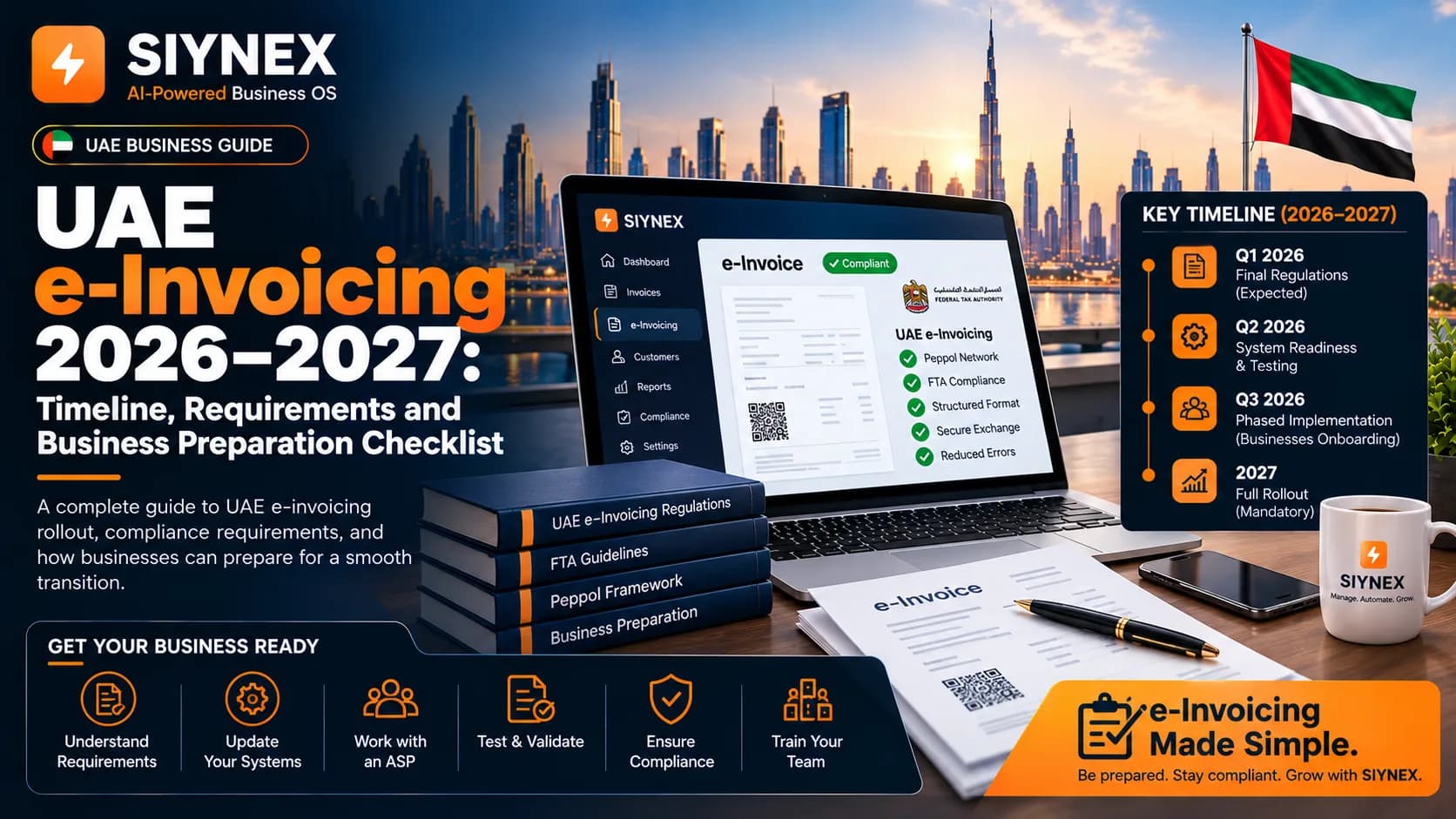
The Complete UAE e-Invoicing Phase Timeline
| Phase | Who Is Covered | ASP Appointment Deadline | Mandatory Go-Live |
|---|---|---|---|
| Pilot / Voluntary | Selected businesses and early adopters | By agreement / onboarding | From 1 July 2026 |
| Phase 1 | Annual revenue of AED 50 million or more | 30 October 2026 | 1 January 2027 |
| Phase 2 | Annual revenue below AED 50 million | 31 March 2027 | 1 July 2027 |
| Phase 3 (Government) | Government entities in scope | 31 March 2027 | 1 October 2027 |
| Intra-VAT-Group Transactions | Members of the same UAE VAT group | Grace period | 1 January 2029 |
One important note on Phase 1 timing: The ASP appointment deadline of 30 October 2026 has already been extended once (from 31 July 2026). Do not assume it will be extended again. The go-live date of 1 January 2027 has not changed and is not expected to move.
Who Is In Scope — Including Businesses That May Assume They Are Not
The scope of UAE e-invoicing is deliberately broad. Several categories of business commonly assume they are exempt — they are not.
Revenue threshold basis
The AED 50 million threshold applies to gross income for the most recent accounting period, based on audited financial statements (or FTA-acceptable alternative documentation if statements are unavailable). This is gross revenue — not taxable revenue, not profit. B2C revenue is included in the calculation even though B2C transactions are not yet mandated for e-invoicing.
VAT registration is not the deciding factor
E-invoicing applies to businesses conducting business in the UAE, irrespective of their VAT registration status. A business that is not VAT-registered because it is below the mandatory registration threshold (AED 375,000) may still be in scope for e-invoicing if its gross revenue exceeds the applicable phase threshold.
Non-VAT-registered businesses in scope must obtain a Tax Identification Number (TIN) through FTA onboarding — separate from the Tax Registration Number (TRN) that VAT-registered businesses hold.
Free Zone businesses are in scope
Operating in a UAE Free Zone does not exempt a business from e-invoicing requirements. Free Zone companies conducting B2B and B2G transactions in scope are subject to the same phase timeline as mainland businesses.
Branches and overseas persons
Branches of foreign companies operating in the UAE and certain non-UAE persons conducting business in the UAE are also within scope.
What is currently excluded
The following are currently excluded or narrowed in scope:
- B2C (business-to-consumer) transactions are outside the mandate for the 2026–2027 phases. Note: the Ministry of Finance may extend the mandate to B2C by separate ministerial decision in the future.
- Sovereign government activities that do not compete with the private sector
- Airline passenger transport using standard e-tickets
- Airline ancillary services using Electronic Miscellaneous Documents (EMDs)
- International goods transport supported by airway bills — a 24-month transitional exemption applies
- VAT-exempt or zero-rated financial services as described under Article 42 of the VAT Executive Regulation
- Businesses that are exclusively B2C in their operations
The Technical Architecture: How UAE e-Invoicing Works
UAE e-invoicing uses a five-corner Peppol-based model. Understanding how the system works helps businesses grasp what they need to build, integrate, and test.
The five corners:
What this means in practice:
This is not a system where invoices are uploaded to a central portal and approved. Invoices flow directly between supplier and buyer through their respective ASPs, with tax data simultaneously reported to the FTA. This is faster than clearance-model systems (such as Saudi Arabia's Fatoora) but requires each business to have its own active ASP connection.
Peppol Participant Identifier
Every business in scope needs a Peppol Participant Identifier — the address that identifies them on the UAE Peppol network. The format is scheme code 0235 followed by the business's 10-digit Tax Identification Number (TIN). For VAT-registered businesses, the TIN is the first 10 digits of their 15-digit TRN.
Businesses obtain their Participant Identifier through EmaraTax as part of ASP onboarding.
Transitional endpoint identifiers
Three special endpoints handle edge cases:
0235:9900000098— UAE business buyer not yet onboarded to e-invoicing0235:9900000097— deemed supplies0235:9900000099— exports to customers without a Peppol ID
The required XML format
Invoices must be formatted in XML under the Peppol PINT-AE billing specifications and UAE data requirements. Businesses do not necessarily need to produce raw XML directly — an ERP or accounting system can pass structured data to the ASP, which handles format conversion and validation.
Six document types in scope
The UAE e-invoicing framework covers six document types:
Note: no QR code or barcode is required on the electronic invoice itself (unlike some other Gulf e-invoicing systems).
Accredited Service Providers (ASPs): What You Need to Know
The ASP is the critical link between your business and the UAE e-invoicing network. Choosing and onboarding an ASP correctly is not optional — it is the first mandatory action in the compliance process.
What an ASP does:
- Connects your business to the UAE Peppol network
- Validates outgoing invoices against PINT-AE and UAE mandatory field requirements before transmission
- Sends invoices to buyer ASPs
- Receives inbound invoices from supplier ASPs and delivers them to you
- Reports Tax Data Documents (TDDs) to the FTA for every invoice exchanged
- Sends and receives status messages that confirm exchange and reporting
What an ASP does not do:
Appointing an ASP does not transfer responsibility for invoice accuracy, VAT treatment, or record retention to the ASP. Your business remains fully responsible for the content of invoices. The ASP is the transmission and validation infrastructure — not a compliance guarantee.
One ASP per business (generally)
Each in-scope business should use one ASP for both sending and receiving invoices. VAT group members are onboarded separately — each member with its own TIN and Participant Identifier — and members of the same VAT group may use different ASPs if they choose.
ASP onboarding runs through EmaraTax
Businesses do not contact ASPs independently and then separately notify the FTA. Onboarding is managed through the EmaraTax portal, which records the appointment and issues the Participant Identifier.
Phase 1 ASP deadline: 30 October 2026
Large businesses (AED 50 million revenue and above) must complete ASP appointment through EmaraTax by 30 October 2026. The go-live date of 1 January 2027 does not move based on when within the window you appoint your ASP — all Phase 1 businesses go live on the same date.
Phase 2 ASP deadline: 31 March 2027
Smaller businesses must appoint their ASP by 31 March 2027, with go-live on 1 July 2027.
Selecting your ASP
The Ministry of Finance publishes the list of accredited ASPs. Check the current list on the FTA portal (tax.gov.ae) before selecting a provider. The number of accredited ASPs has been growing — as of mid-2026, multiple ASPs were approved, and more were in the accreditation pipeline. Evaluate providers on UAE e-invoicing readiness, ERP integration capability, technical support, and pricing.
Mandatory Fields and Data Requirements
Electronic invoices under the UAE PINT-AE standard must carry specific mandatory fields. The exact set depends on the document type and transaction scenario, but the core mandatory fields across standard Electronic Tax Invoices include:
Supplier information:
- Supplier name
- Supplier address
- TRN (Tax Registration Number) for VAT-registered suppliers
- TIN for non-VAT-registered suppliers in scope
Buyer information:
- Buyer name
- Buyer address
- Buyer TRN or TIN (where applicable)
Invoice details:
- Invoice number (unique sequential reference)
- Invoice date
- Invoice type code
- Currency code
Line item details:
- Description of goods or services
- Quantity
- Unit price
- Line extension amount
- VAT category code (standard, zero, exempt)
- VAT rate
- VAT amount per line
Totals:
- Subtotal (excluding VAT)
- Total VAT amount
- Total payable amount (including VAT)
For Free Zone transactions: Beneficiary information must be included in addition to customer information — this is an additional UAE-specific data requirement.
Document references: Where an invoice relates to a prior document (for example, a final invoice referencing an advance invoice), the reference must be included.
Data quality matters as much as data completeness. An invoice that contains a supplier's TRN with a typo, an incorrect VAT category code, or a buyer name that does not match FTA records will fail ASP validation before it is transmitted. Master data cleansing — verified TRNs, accurate customer details, correct addresses — is not a final step in preparation. It is one of the first.
Special Scenarios Your Business Needs to Plan For
Beyond standard invoices, several transaction scenarios require specific handling that businesses must test before go-live.
Advance payments
When a business receives an advance payment before delivering goods or services, an electronic tax invoice must be issued at the point the advance is received — not when delivery occurs. The final invoice, when issued, covers only the remaining balance and must reference the advance invoice.
Retention billing
Issue an electronic invoice for the amount currently payable, reflecting the amount released from retention. A separate electronic invoice is issued for the retained amount when it becomes due and payable.
Intra-VAT-group transactions
Transactions between members of the same UAE VAT group are in scope for e-invoicing, but a 24-month grace period applies from 1 January 2027 through 31 December 2028. The mandatory date for intra-group electronic exchange is 1 January 2029.
Exports
Exports to customers without a Peppol ID use the transitional endpoint 0235:9900000099. The invoice is still transmitted through the UAE Peppol network, but routed to the designated export endpoint rather than the buyer's ASP.
Error correction
Once an invoice is approved by the supplier's ASP, the only compliant correction method is an electronic credit note. Voiding or cancelling invoices through any other means is not compliant. This requires businesses to design their approval workflows so that errors are caught before ASP submission, not after.
The Penalty Schedule
Cabinet Decision No. 106 of 2025 establishes the administrative penalties for e-invoicing non-compliance. These are not hypothetical — they apply from the mandatory go-live date.
| Violation | Penalty |
|---|---|
| Failing to implement the e-invoicing system or appoint an ASP by the deadline | AED 5,000 per month (or part of a month) |
| Late issuance or transmission of an electronic invoice | AED 100 per invoice, capped at AED 5,000 per month |
| Late issuance or transmission of an electronic credit note | AED 100 per document, capped at AED 5,000 per month |
| Failure to report a system failure to the FTA on time | AED 1,000 per day (or part of a day) |
| Failure to notify the ASP of changes to FTA-registered data on time | AED 1,000 per day (or part of a day) |
- System failures must be reported to the FTA within 2 business days of occurrence
- Changes to FTA-registered information must be notified to the ASP within 5 business days of the FTA's confirmation of the change
For a business issuing 200 invoices per month that fails to go live on 1 January 2027, the penalty exposure accumulates quickly: AED 5,000 per month for non-implementation plus AED 100 per late invoice (capped at AED 5,000 per month from that category). The combined monthly exposure from two violation types alone is AED 10,000.
Record Retention Under e-Invoicing
Storage requirements under UAE e-invoicing:
- Taxable persons: Records must be retained for 5 years after the end of the relevant tax period
- Other in-scope persons (non-VAT-registered): Records must be retained for 5 years after the end of the calendar year in which the document was created
- Real estate transactions: 7 years after the end of the relevant calendar year
Storage can be inside or outside the UAE, provided that records remain secure, retain their integrity, and can be produced to the FTA promptly upon request. Note that the FTA has the right to access and use e-invoicing system data, and may share it with other UAE government entities or with foreign tax authorities under international exchange-of-information agreements.
One critical point: Your ASP is responsible for transmitting and reporting invoices. It is not responsible for your record retention. Businesses must ensure that their own systems retain the required records for the required periods — the ASP connection alone does not satisfy the retention obligation.
The Business Preparation Checklist
This checklist is structured in the sequence that UAE e-invoicing implementation should follow. Starting at Step 5 without completing Steps 1–4 is the most common source of implementation delays.
Step 1: Confirm your phase and revenue threshold
Determine which phase applies to your business. Review your most recent audited financial statements and calculate gross income. If your gross income is AED 50 million or more, you are in Phase 1 — the ASP appointment deadline is 30 October 2026 and go-live is 1 January 2027. If below AED 50 million, you are in Phase 2 — ASP deadline 31 March 2027, go-live 1 July 2027.
If your business does not have audited financial statements, identify the alternative documentation acceptable to the FTA for threshold assessment.
☐ Revenue threshold confirmed
☐ Phase confirmed (Phase 1 / Phase 2 / Government)
☐ ASP appointment deadline noted
☐ Go-live date noted
Step 2: Confirm your scope — transactions and exclusions
Map all your invoice flows: B2B, B2G, intra-group. Identify which transactions are in scope and which fall within the current exclusions (B2C, sovereign activities, airline documents, applicable financial services).
☐ B2B invoice flows mapped
☐ B2G invoice flows identified
☐ Intra-VAT-group transactions identified (note: grace period to 1 January 2029)
☐ Exclusions confirmed and documented
☐ Export invoice flows identified (transitional endpoint planning)
Step 3: Assess your current invoicing systems and gaps
Review your current invoicing workflow against the PINT-AE technical requirements. The key questions:
- Does your ERP or accounting system support XML output?
- Can it produce all mandatory fields in the format required by PINT-AE?
- Does it handle the six document types (tax invoice, tax credit note, commercial invoice, electronic credit note, self-billed variants)?
- Can it handle advance payment invoicing and retention billing workflows?
- Can it produce document references when required?
☐ ERP/accounting system capability assessed
☐ XML/structured data output capability confirmed
☐ Mandatory field gaps identified
☐ System upgrade or configuration requirements scoped
☐ Advance payment and retention workflows reviewed
☐ Error correction (credit note) workflow reviewed
Step 4: Clean your master data
Data quality is the most underestimated step in e-invoicing readiness. An invoice that fails ASP validation does not transmit — it is treated as not issued. Validation failures at scale create operational disruption and potential late-invoice penalties.
Clean and verify:
☐ All customer TRNs verified against the FTA portal (tax.gov.ae)
☐ All supplier TRNs verified
☐ Customer and supplier names match FTA-registered names
☐ Customer addresses are accurate and complete
☐ VAT category codes for all products and services are correct
☐ Free Zone customer beneficiary information is collected and accurate
Step 5: Select an Accredited Service Provider (ASP)
Check the current list of FTA-accredited ASPs on the official FTA portal. Evaluate shortlisted providers on:
- UAE e-invoicing technical readiness (PINT-AE certified)
- Integration method: direct API, ERP connector, middleware
- Compatibility with your specific ERP or accounting system
- Support for all six document types
- Customer support quality and availability
- Penalty coverage or SLA in case of ASP-side failures
- Pricing structure (per-invoice, subscription, or hybrid)
☐ FTA-accredited ASP list reviewed
☐ ASPs shortlisted and evaluated
☐ ASP selected
☐ Contract or service agreement executed
Step 6: Onboard through EmaraTax and obtain your Participant Identifier
ASP onboarding runs through the EmaraTax portal, not directly through the ASP. The outcome of onboarding is your Peppol Participant Identifier — the address that identifies your business on the UAE Peppol network.
☐ EmaraTax onboarding initiated
☐ Participant Identifier obtained (format: 0235 + 10-digit TIN)
☐ ASP appointment confirmed in EmaraTax
Step 7: Integrate and configure your systems
Connect your ERP or accounting system to your ASP. This may be a direct API integration, a middleware connector, or a file-based exchange depending on your system and ASP. Configure all mandatory fields, document type codes, VAT category codes, and document reference logic.
☐ API or connector integration between ERP and ASP completed
☐ Mandatory fields mapped and configured
☐ Six document types configured
☐ VAT category codes validated in the integrated system
☐ Document reference logic configured (advance, retention, corrections)
☐ Free Zone beneficiary fields configured (if applicable)
Step 8: Test end-to-end before go-live
Testing must cover the full invoice lifecycle — not just successful transmission. Test:
☐ Successful outbound invoice transmission (supplier to buyer)
☐ Successful inbound invoice receipt (buyer from supplier)
☐ Status message receipt and processing
☐ Failed invoice handling (what happens when validation rejects an invoice)
☐ Electronic credit note issuance and transmission
☐ Advance payment invoice and final invoice flow
☐ Large-volume stress testing (can your system handle peak invoice volumes without delay?)
☐ Error and exception escalation workflows
Step 9: Set up system failure reporting procedures
System failures must be reported to the FTA within 2 business days. This is not automatic — your business needs a procedure that:
- Defines what constitutes a reportable system failure
- Identifies who is responsible for reporting
- Documents the FTA notification channel and process
- Tracks reported failures and resolution
☐ System failure definition and escalation procedure documented
☐ FTA notification process confirmed
☐ 2-business-day reporting SLA understood and assigned
Step 10: Train staff and go live
E-invoicing compliance is not just an IT project. Finance, operations, customer-facing, and procurement teams all need to understand the new workflow — what changes, what stays the same, and what to do when something goes wrong.
☐ Finance team trained on new invoice issuance workflow
☐ Procurement team trained on inbound invoice receipt workflow
☐ IT/support team trained on ASP monitoring and error handling
☐ Go-live date communicated to key customers and suppliers
☐ Major customers and suppliers confirmed to have their own ASP connections
Common Mistakes to Avoid
Based on patterns seen across the region as e-invoicing mandates have rolled out, these are the preparation errors most likely to cause problems for UAE businesses.
Treating a PDF as an e-invoice. The single most widespread misconception. A PDF is not an electronic invoice under UAE law, however it is delivered. Businesses that continue sending PDF invoices after their go-live date are non-compliant from day one.
Relying on the original July 2026 ASP deadline. Ministerial Decision No. 66 of 2026 extended Phase 1's ASP appointment deadline from 31 July 2026 to 30 October 2026. Some businesses may have set internal plans around 31 July and then relaxed when the extension was announced. The 30 October 2026 deadline is firm.
Assuming non-VAT-registered or Free Zone businesses are out of scope. They are not. If your gross revenue exceeds the threshold, e-invoicing applies — regardless of VAT registration status or Free Zone location.
Starting integration at go-live. The ASP onboarding, ERP integration, data mapping, and end-to-end testing sequence takes weeks, not days. Businesses that begin integration after their ASP appointment deadline (rather than as soon as ASP is selected) risk not being ready for their go-live date.
Neglecting master data quality. An invoice with a wrong TRN, an incorrect customer name, or a missing mandatory field fails ASP validation and is not transmitted. At scale, data quality failures create penalty exposure and operational disruption. Data cleansing should begin at Step 4 — before ASP selection, not after.
Assuming the ASP handles record retention. The ASP transmits and reports invoices. Retention of records for the required statutory period (5 or 7 years) is the business's own responsibility.
Ignoring advance payment and retention workflows. These are not edge cases for most UAE businesses in construction, consulting, or services. They require specific electronic invoice sequences (advance invoice at payment receipt, final invoice for balance with reference to the advance) that must be configured and tested before go-live.
How SIYNEX Can Support e-Invoicing Preparation
SIYNEX currently helps businesses create and track ordinary invoices with client, line-item and VAT information. Those operational records can help a business identify data-quality gaps before it begins a separate e-invoicing implementation.
SIYNEX does not currently generate PINT-AE XML, connect directly to an Accredited Service Provider, obtain a Peppol Participant Identifier, transmit structured invoices, report Tax Data Documents to the FTA, or guarantee e-invoicing compliance. A PDF or client-facing invoice link created in SIYNEX is not a structured UAE electronic invoice.
Use the preparation checklist in this article with your own finance and technical teams. Confirm scope, deadlines and implementation requirements with the Ministry of Finance, the FTA, an accredited service provider and qualified UAE tax advisers before making compliance decisions.
Review SIYNEX's current invoicing workflow
Frequently Asked Questions
Q: Does UAE e-invoicing apply to my business if I am not VAT-registered?
Potentially yes. E-invoicing applies to businesses conducting business in the UAE, regardless of VAT registration status. The determining factor is your gross annual revenue against the phase threshold (AED 50 million for Phase 1, below AED 50 million for Phase 2). If your revenue exceeds the threshold for your phase, e-invoicing applies even if you are not VAT-registered. Non-VAT-registered businesses in scope must obtain a Tax Identification Number (TIN) through FTA onboarding.
Q: My business is in a UAE Free Zone. Am I exempt?
No. Operating in a UAE Free Zone does not exempt a business from e-invoicing requirements. Free Zone companies conducting B2B and B2G transactions in scope are subject to the same phase timeline and technical requirements as mainland businesses.
Q: Is sending invoices by email as PDF compliant with UAE e-invoicing?
No. A PDF invoice — however it is delivered — is not an electronic invoice under UAE law. An electronic invoice is a structured XML document exchanged through an accredited service provider over the Peppol network. A PDF can accompany an electronic invoice as a human-readable copy, but it does not replace it.
Q: My business issues invoices within our UAE VAT group. Do e-invoicing rules apply to those?
Yes, but with a grace period. Intra-VAT-group transactions are in scope for e-invoicing, but the mandatory electronic exchange requirement for these transactions does not apply until 1 January 2029. Businesses have until then to prepare their intra-group invoice workflows for compliance.
Q: What happens if my e-invoicing system fails after go-live?
A system failure must be reported to the FTA within 2 business days. Failure to report on time carries a penalty of AED 1,000 per day of delay. The business is responsible for having documented failure-reporting procedures in place before go-live — this is not something to figure out after a system outage occurs.
Q: Can I use multiple ASPs?
In general, each business should use one ASP for both sending and receiving. However, in a VAT group, different group members may use different ASPs — because each member has its own TIN and Participant Identifier and is onboarded separately.
Q: Does the UAE e-invoicing system work like Saudi Arabia's Fatoora — where invoices need to be approved by the authority before they are sent?
No. UAE e-invoicing uses a decentralised Peppol model, not a clearance model. Invoices flow directly from the supplier's ASP to the buyer's ASP, with Tax Data Documents simultaneously reported to the FTA. The FTA receives data in near real time but does not pre-approve invoices before transmission. This is operationally faster than a clearance system but requires both parties to have active ASP connections.
Q: What is my Peppol Participant Identifier and how do I get it?
Your Peppol Participant Identifier is the address that identifies your business on the UAE Peppol network. It is formatted as scheme code 0235 followed by your 10-digit TIN (for VAT-registered businesses, this is the first 10 digits of your TRN). You obtain it through EmaraTax as part of your ASP onboarding process.
Summary
UAE e-invoicing is one of the most significant operational changes the UAE tax framework has introduced. It is not an administrative adjustment — it is a structural change to how invoices are created, transmitted, validated, and reported. For businesses in Phase 1, the ASP appointment deadline is 30 October 2026 and the go-live date is 1 January 2027. For Phase 2 businesses, the ASP deadline is 31 March 2027 and go-live is 1 July 2027.
The preparation sequence is clear: confirm your phase and scope, map your transaction flows, assess your system gaps, clean your master data, select an accredited ASP, onboard through EmaraTax, integrate and test, and set up your failure-reporting procedures. None of these steps can be skipped, and several cannot be rushed.
The businesses that will experience the smoothest transition are the ones treating e-invoicing not as a compliance project to complete before a deadline, but as an operational infrastructure change that requires early, careful, and properly sequenced preparation.
Last updated: October 2026 | This article reflects UAE e-invoicing requirements as of October 2026, including Ministerial Decision No. 243 of 2025, Ministerial Decision No. 244 of 2025 (as amended by Ministerial Decision No. 66 of 2026), and Cabinet Decision No. 106 of 2025. Regulatory requirements can change — always verify current deadlines and specifications on the official FTA portal (tax.gov.ae) and consult a UAE-registered tax agent or technology advisor for implementation guidance specific to your business. This article does not constitute tax, legal, or technology advice.