Introduction
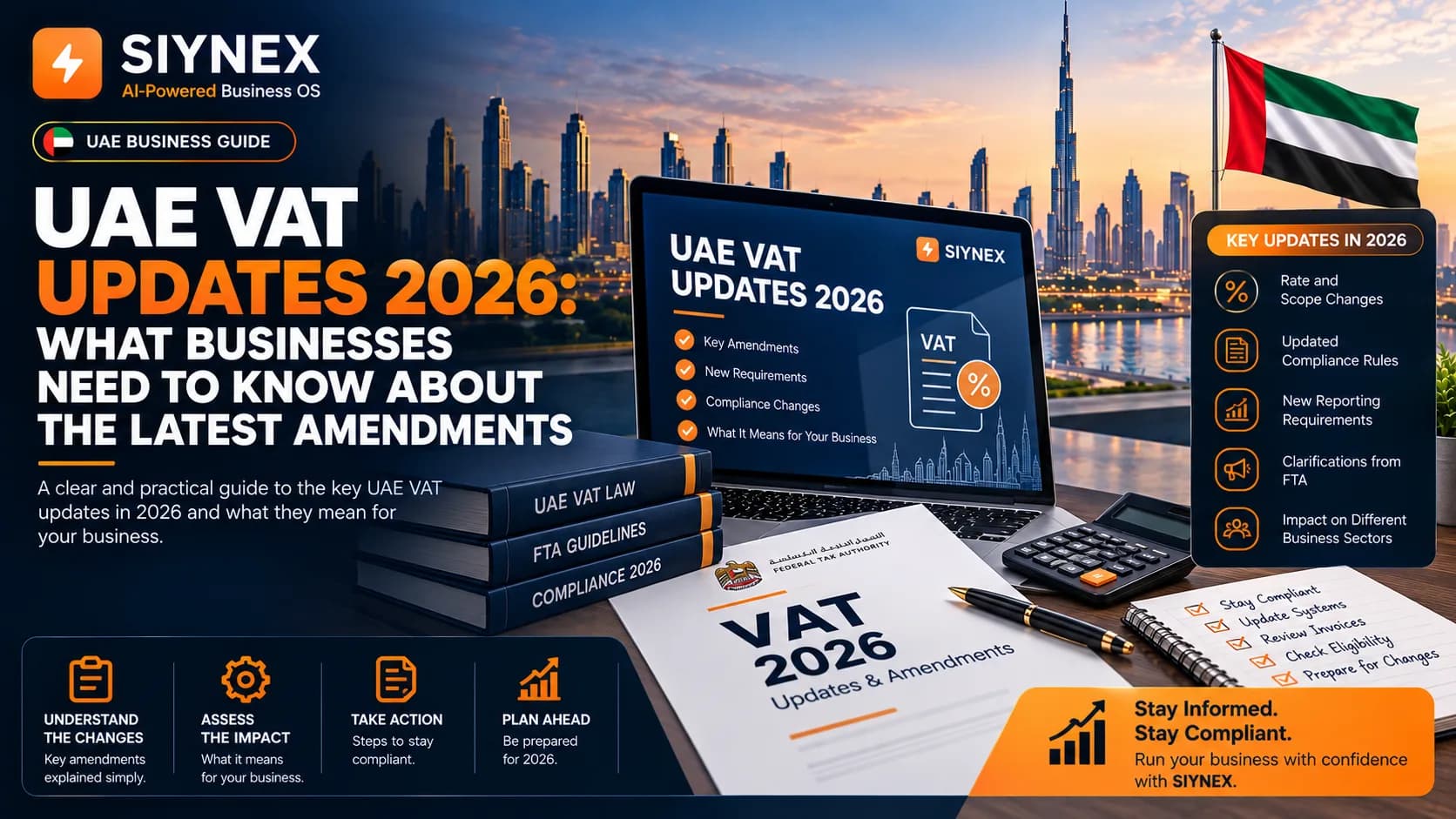
The UAE VAT framework changed twice in 2026 — and both rounds of amendments are now in force.
The first wave took effect on 1 January 2026, introduced through Federal Decree-Law No. 16 of 2025. It removed the requirement to self-invoice under the reverse charge mechanism, introduced a five-year time limit on carrying forward input VAT credit balances, and empowered the FTA to deny input tax recovery where a supply chain involved tax evasion.
The second wave took effect on 1 October 2026, introduced through Cabinet Decision No. 149 of 2026. It amended the VAT Executive Regulation with targeted changes to composite supply treatment, employee benefit input tax recovery, healthcare product zero-rating, capital asset scheme rules, profit margin scheme purchase price calculations, credit note requirements, and — most significantly — a fundamental revision to the standard method of input tax apportionment (though this final change does not apply until the first tax year commencing after 1 October 2027).
Together, these amendments represent the most comprehensive revision to the UAE VAT framework since the tax was introduced in 2018. The 5% standard rate has not changed. The core VAT structure remains intact. But how certain supplies are treated, how input tax is recovered and apportioned, and how the FTA enforces the framework has changed materially.
This article explains every significant amendment, what it means for your business in practical terms, and what action — if any — each change requires from you.
Wave 1: Federal Decree-Law No. 16 of 2025 — Changes Effective 1 January 2026
The first round of 2026 amendments was issued through Federal Decree-Law No. 16 of 2025, amending the original Federal Decree-Law No. 8 of 2017 on Value Added Tax. Three substantive changes came into effect on 1 January 2026.
Amendment 1: Reverse Charge — Self-Invoicing No Longer Required
What changed:
Under the previous UAE VAT rules, when a business applied the reverse charge mechanism — for example, when importing services from an overseas supplier not registered for UAE VAT — the business was required to issue itself a self-invoice. This document was then used as evidence to support the input VAT recovery claim.
From 1 January 2026, taxpayers are no longer required to self-invoice for cross-border imports of goods and services made for business purposes. Self-invoicing may still be used to support VAT recovery where supplier documentation is unavailable, but it is no longer a mandatory step in the reverse charge process.
What it means in practice:
For businesses that regularly import services — cloud software subscriptions, overseas consultancy, international legal or accounting fees, SaaS platform costs — the administrative burden of generating self-invoices for each transaction is eliminated. The obligation to apply the reverse charge mechanism itself remains unchanged: businesses must retain supporting documents related to supply transactions, as specified by the Executive Regulation.
The reverse charge still applies. The tax still needs to be declared in your VAT return (Box 4) and reclaimed as input VAT (Box 9). The only change is that you no longer need to generate a self-invoice document to support that process — your supplier's invoice and the supporting transaction documentation are sufficient.
Action required:
Review your reverse charge process. If you were generating self-invoices as part of your standard workflow, update your process to reflect that supporting supplier documentation is now the primary record. Ensure those supplier records are retained as specified by the FTA.
Amendment 2: Five-Year Time Limit on Carrying Forward Excess Input VAT
What changed:
From 1 January 2026, a strict five-year time limit has been introduced for carrying forward and claiming excess recoverable input VAT. Previously, VAT credits arising in early periods could be carried forward indefinitely.
Under the amended rules, any excess input VAT credit must be claimed as a refund or used to offset VAT liabilities within five years from the end of the tax period in which it arose. Credits that are not claimed within this window are forfeited.
A transitional provision applies: businesses with existing refunds that have expired or will expire within one year from 1 January 2026 must request a refund before 1 January 2027. This is the most time-sensitive provision in the entire 2026 amendment package.
VAT credits arising in early 2021 should be reviewed as a priority, as the five-year carry-forward period for those credits will begin to expire during 2026.
What it means in practice:
Businesses that have accumulated VAT credit balances — common among exporters, zero-rated supply businesses, and businesses that have made large capital expenditures — must now actively manage those credits against a rolling five-year clock.
A VAT credit that arose in Q1 2021 (tax period ending March 2021) must be claimed by the end of Q1 2026 (by 28 April 2026 if on the standard cycle). If this deadline has already passed for some of your credits, those specific credits may have been forfeited.
Action required — this is urgent if you have legacy VAT credit balances:
- Identify all VAT credit balances currently on your EmaraTax account
- Determine the tax period in which each credit arose
- Calculate which credits are within five years of expiry
- Submit refund claims for any credits approaching or within the five-year window — particularly credits from 2021 and 2022
- If you have credits from 2021 that have not yet been claimed, the deadline for some of these may be imminent or already passed. Check your EmaraTax account and contact a UAE tax agent immediately if this applies to you
Amendment 3: FTA Power to Deny Input Tax in Cases of Tax Evasion
What changed:
The amendments authorise the Federal Tax Authority to deny the deduction of input tax if it determines that the supply forms part of a tax-evasion arrangement. Taxpayers are required to verify the legitimacy and integrity of supplies before deducting input tax, in line with the procedures and measures set out by the FTA.
The FTA has issued FTA Decision No. 13 of 2026 to operationalise this provision. Under the amended framework, input VAT recovery can be denied in two scenarios:
- Actual knowledge: The business knew, at the time of claiming input VAT, that the supply was part of a tax evasion arrangement
- Constructive knowledge: The business should have known, based on the circumstances, that the supply or its VAT treatment was improper
The FTA can look beyond the immediate supplier to anyone in the supply chain. This is the most significant governance change in the January amendments — it introduces a duty of care on VAT-registered businesses to conduct supplier verification before claiming input VAT.
What it means in practice:
This amendment has direct operational implications for UAE businesses in two ways.
First, supplier due diligence is no longer simply good practice — it is a prerequisite for VAT recovery. If a supplier is later found to be part of an evasion scheme, and the FTA determines you should have known (based on pricing anomalies, the supplier's profile, or the circumstances of the transaction), your input VAT claim on that supply can be denied retroactively.
Second, the "should have known" standard is deliberately broad. The FTA has not published a prescriptive list of what supplier verification requires. This creates ambiguity but also imposes a clear obligation: businesses must have a documented process for verifying supplier legitimacy, and that process must be proportionate to the risk of each supplier relationship.
Action required:
- Establish or formalise a supplier verification process — at minimum, verify that each supplier is VAT-registered on the FTA portal (tax.gov.ae) before claiming input VAT from them
- For higher-value or higher-risk supplier relationships, consider additional due diligence steps (verification of trade licence, confirmation of business activities, documentation of the commercial rationale)
- Document your verification process — not just the fact of verification but the records that support it
- Review existing supplier relationships for any that present anomalies in pricing, VAT treatment, or documentation
Wave 2: Cabinet Decision No. 149 of 2026 — Changes Effective 1 October 2026
On 1 September 2026, the UAE Cabinet issued Cabinet Decision No. 149 of 2026, amending certain provisions of Cabinet Decision No. 52 of 2017 on the Executive Regulation of Federal Decree-Law No. 8 of 2017 on Value Added Tax. Most of the amendments took effect from 1 October 2026.
The amendments introduce a number of technical and operational changes across the VAT framework, with the aim of aligning VAT treatment with economic substance and international practice, improving legal clarity and ease of compliance for businesses, and protecting the tax base.
These changes are now in force for all UAE VAT-registered businesses. Here is each one explained.
Amendment 4: Composite Supplies — New Statutory Rule
What changed:
An anti-fragmentation rule has been added: supplies with multiple interconnected components that cannot realistically be separated must be treated as a single supply, with the principal component determining the VAT treatment.
Previously, the UAE VAT framework lacked a specific statutory rule for composite supplies. This amendment fills that gap explicitly.
What it means in practice:
When a business provides a bundle of goods or services that are genuinely interconnected — for example, a software platform with mandatory implementation services, or a medical device sold with mandatory training — the entire supply must be treated as a single supply for VAT purposes, with the VAT rate determined by the principal element.
You cannot artificially split a composite supply to benefit from a lower VAT rate on one component. The economic substance of the supply determines whether components are genuinely separable.
Action required:
Review your product and service bundles. Where you currently invoice separate components with different VAT rates, assess whether those components are genuinely separable under the new rule. If they are not, the supply should be treated as a single composite supply taxed at the rate of the principal component.
Amendment 5: Employee Benefit Input Tax Recovery — Expanded but Evidentially Dependent
What changed:
Input tax recovery has been expanded to cover goods and services provided under documented company policies, contractual obligations, or statutory requirements under UAE labour laws (including free zone regulations), subject to FTA conditions.
Employee benefit input tax recovery is broadened but made more evidentially dependent: recovery is allowed where benefits are mandatory under UAE labour or free zone law, or where provided under a contractual obligation or documented policy, subject to FTA conditions. Employer accommodation remains blocked unless mandated by MOHRE directives.
What it means in practice:
Under the previous rules, input VAT recovery on employee benefits was largely blocked or uncertain. The amended rules allow recovery where:
- The benefit is required by UAE Labour Law (Federal Decree-Law No. 33 of 2021) or applicable free zone employment regulations
- The benefit is provided under a documented contractual obligation or a written company policy
This is a meaningful expansion for businesses that provide benefits — gym memberships required under employment contracts, transport allowances documented in HR policy, accommodation provided under statutory obligations — but recovery is conditional on proper documentation.
Employer-provided accommodation remains blocked for input VAT recovery unless the MOHRE specifically directs that accommodation be provided — an obligation that applies to limited categories of worker.
Action required:
- Review your employee benefits programme against the new recovery criteria
- Ensure that benefits you intend to claim input VAT on are documented in employment contracts, HR policies, or linked to a statutory obligation under UAE Labour Law
- Update your VAT coding to reflect which benefits are now recoverable
- Watch for FTA guidance on the specific conditions that must be met — this detail is expected to be published following Cabinet Decision No. 149
Amendment 6: Healthcare Products — Consolidated Zero-Rating Category
What changed:
The amendment consolidates the separate categories of pharmaceutical products and medical equipment into a single category of "medical products," as specified in a Cabinet Decision. The wording is streamlined from separate references to Cabinet-specified pharmaceutical products and medical equipment to "medical products" specified by Cabinet Decision.
What it means in practice:
For most healthcare businesses, this is a consolidation and simplification rather than a substantive change to the scope of zero-rating. The practical scope of zero-rating for healthcare products will be determined by the Cabinet Decision that specifies what constitutes a "medical product."
Action required:
Healthcare and pharmaceutical businesses should monitor the Cabinet Decision that defines "medical products" under this new framework and update their VAT treatment coding once the list is confirmed. Until that Cabinet Decision is published, apply existing VAT treatment to pharmaceutical products and medical equipment as previously classified.
Amendment 7: Cash-Settled Supply Input VAT Restriction
What changed:
A new restriction on cash transactions has been introduced: large cash payments may lose input VAT deduction. The detailed mechanics — including the AED threshold amount — will be issued via a forthcoming Ministerial Decision.
What it means in practice:
The specific threshold above which cash payments lose their input VAT recovery entitlement has not yet been published. This amendment is an anti-fraud measure — large cash transactions in certain sectors have been a mechanism for VAT evasion, and denying input VAT recovery on cash payments above the threshold reduces the incentive.
Action required:
Monitor FTA and Ministry of Finance publications for the Ministerial Decision setting the cash-payment threshold. Once published, review your accounts payable processes to identify any suppliers you pay in cash above the threshold and assess whether those payment arrangements should be restructured.
Amendment 8: Capital Asset Scheme — Scope Updated
What changed:
The Capital Asset Scheme — which governs the adjustment of input VAT recovery on capital assets over their useful life — has been updated to keep the scheme consistent with the underlying VAT Law. The AED 5 million threshold, the requirement that VAT must be payable, and the applicable useful-life conditions remain unchanged.
What it means in practice:
For most SMEs, the capital asset scheme applies to assets with a cost of AED 5 million or more — a threshold that places this amendment outside the immediate concern of most small businesses. Businesses operating in real estate development, large-scale construction, or capital-intensive manufacturing should review the updated scheme provisions with their tax advisor.
Amendment 9: Profit Margin Scheme — Purchase Price Rules Updated
What changed:
The Profit Margin Scheme — available to businesses dealing in second-hand goods, antiques, and similar items — has been updated to clarify how the purchase price is calculated for margin VAT purposes.
What it means in practice:
If your business operates under the Profit Margin Scheme (typically applicable to second-hand vehicle dealers, antique dealers, and resellers of second-hand goods), review the updated purchase price calculation rules and confirm your margin VAT calculations remain accurate under the revised provisions.
Amendment 10: Tax Credit Note Requirements — Clarified
What changed:
The provisions governing tax credit notes have been updated and clarified. Documents issued under the credit note provisions must be labelled correctly, with specific requirements for the document format and content.
What it means in practice:
Businesses that issue credit notes — for returns, cancellations, price adjustments, or corrections to previously issued tax invoices — should confirm that their credit note templates and workflows comply with the updated requirements. The label "Tax Credit Note" (or equivalent compliant label as specified by the FTA) must appear on the document.
Action required:
Review your credit note template against the updated requirements. If your credit notes are generated automatically by your invoicing system, confirm that the system is producing documents that comply with the revised format requirements.
Amendment 11: Input Tax Apportionment Method Revised — Effective After October 2027
What changed:
The most significant change under Cabinet Decision No. 149 of 2026 is a fundamental revision to the standard method of input tax apportionment. The default calculation shifts from an input-tax ratio to an outputs-value ratio — taxable supplies as a proportion of total supplies.
Unlike other amendments, the revised partial exemption framework has a longer transition runway and applies from the first tax year commencing after 1 October 2027.
This amendment affects businesses that make both taxable and exempt supplies — for example, businesses in financial services, real estate, or education. The standard method for calculating how much input VAT they can recover will change from a ratio based on input tax values to a ratio based on output supply values.
What it means in practice:
For fully taxable businesses (those that only make VAT-taxable supplies), this amendment has no immediate effect — there is no apportionment calculation to apply.
For businesses with mixed supplies, this is a significant methodological change that requires advance modelling. Businesses should model the new value-based input tax apportionment methodology before the first Tax Year starting after 1 October 2027.
Action required:
- Identify whether your business makes exempt supplies alongside taxable ones
- If yes: engage a UAE tax advisor to model the impact of the revised apportionment method on your recoverable input VAT position
- Start this modelling now — the transition requires system and process readiness that takes time to implement
Summary of All 2026 UAE VAT Changes — Quick Reference
| # | Amendment | Effective Date | Who Is Affected |
|---|---|---|---|
| 1 | Reverse charge self-invoicing eliminated | 1 January 2026 | All businesses importing services |
| 2 | 5-year limit on input VAT credit carry-forward | 1 January 2026 | Businesses with VAT credit balances — especially from 2021 |
| 3 | FTA power to deny input tax for supply chain evasion | 1 January 2026 | All VAT-registered businesses |
| 4 | Composite supply anti-fragmentation rule | 1 October 2026 | Businesses with bundled product/service offerings |
| 5 | Employee benefit input VAT recovery expanded | 1 October 2026 | Businesses providing employee benefits |
| 6 | Medical products zero-rating consolidated | 1 October 2026 | Healthcare and pharmaceutical businesses |
| 7 | Cash payment input VAT restriction | 1 October 2026 (threshold TBD) | Businesses making large cash payments to suppliers |
| 8 | Capital Asset Scheme scope updated | 1 October 2026 | Large capital-asset businesses (AED 5M+ assets) |
| 9 | Profit Margin Scheme purchase price rules | 1 October 2026 | Second-hand goods dealers |
| 10 | Tax Credit Note requirements clarified | 1 October 2026 | All businesses issuing credit notes |
| 11 | Input tax apportionment method revised | First tax year after 1 October 2027 | Businesses with mixed taxable/exempt supplies |
What These Amendments Mean for UAE SMEs — The Practical Priority List
Not every amendment carries equal urgency for every business. Here is where to focus based on your situation.
Urgent — act before 1 January 2027:
If you have VAT credit balances on your EmaraTax account that arose in 2021 or earlier, the five-year window for those credits is closing. Check your EmaraTax account now. Submit refund claims for any credits approaching the five-year limit. This is not a discretionary action — forfeited credits cannot be recovered.
Immediate — already in force since 1 January 2026:
The supplier verification requirement for input tax recovery is the change with the broadest compliance implication for UAE SMEs. The "should have known" standard means you cannot passively claim input VAT without a documented process for verifying supplier legitimacy. If you do not have one, build it now.
Immediate — already in force since 1 October 2026:
Review your bundled product and service offerings against the composite supply rule. Review your credit note templates against the updated requirements. If your business provides employee benefits, identify which benefits are now recoverable and update your VAT coding.
Watch and prepare — Ministerial Decision pending:
The cash payment input VAT restriction will take effect once the threshold Ministerial Decision is published. Monitor FTA and Ministry of Finance communications and update your accounts payable processes when the threshold is confirmed.
Plan ahead — effective after October 2027:
If your business makes both taxable and exempt supplies, begin modelling the impact of the revised input tax apportionment methodology now. The 2027 effective date allows time to prepare — but system and process changes for a methodology shift take longer than a year to implement properly.
How the 2026 Amendments Affect Your VAT Returns
The amendments do not change the structure of the UAE VAT return form or the deadline (28th of the month after each tax period). However, several amendments affect what goes into specific return boxes.
Reverse charge (Boxes 4 and 9): The obligation to declare reverse charge in your VAT return remains unchanged. What changed is that you no longer need a self-invoice document to support the declaration. Ensure your reverse charge entries are still properly documented — just without the self-invoice requirement.
Input VAT (Box 7): The new supplier verification obligation affects every input VAT claim. Input VAT on invoices from suppliers who are not VAT-registered, or who are later found to be part of an evasion arrangement, is at risk of denial. Build verification into your invoice approval workflow.
Credit balances: If your returns have been accumulating credit balances, the five-year clock is now running. Track credit balance ages and take action before they expire.
How SIYNEX Can Support Operational Record Keeping
SIYNEX helps businesses create and track invoices with client, line-item and VAT information. Where facts required for a supported VAT treatment are incomplete, the workflow can require review instead of silently assigning a treatment. Users can also organize uploaded documents and record reminders for dates they choose.
SIYNEX does not monitor legislation in real time, verify suppliers with the FTA, track VAT credit expiry, maintain a complete VAT ledger, prepare or submit VAT returns, connect directly to EmaraTax, or determine how an amendment applies to a specific transaction. It does not replace professional tax advice.
Review the source legislation and current FTA guidance, reconcile all operational records with the business's accounting system, and obtain qualified advice before changing VAT treatment or filing positions.
Review SIYNEX's current invoicing workflow
Frequently Asked Questions
Q: Has the UAE VAT rate changed in 2026?
No. The standard VAT rate remains 5%. The 2026 amendments introduce procedural and compliance changes but leave the UAE's core VAT structure unchanged. Zero-rating and exemptions for qualifying supplies also remain in place — though the healthcare product categorisation has been consolidated under a new "medical products" definition.
Q: I have a VAT credit balance from 2021. Has it expired?
It depends on the specific tax period in which the credit arose. Under the transitional provisions, credits expiring within one year of 1 January 2026 must be claimed by 1 January 2027. Credits from Q1 2021 (period ending March 2021) would reach the five-year limit by April 2026 — if yours arose in that period, act urgently. Log into EmaraTax, check your credit balance history, and submit a refund claim immediately if the credit is at or near the five-year limit.
Q: Do I still need to apply the reverse charge mechanism on imported services?
Yes. The reverse charge obligation itself is unchanged — it still applies to services imported from overseas suppliers not registered for UAE VAT. What changed is that you no longer need to issue yourself a self-invoice to support the reverse charge claim. Your supplier's invoice and supporting transaction documentation are now the primary records.
Q: What is the "should have known" standard for supplier verification?
The FTA has not published a precise definition of what the "should have known" standard requires. The principle is that a business claiming input VAT should take steps proportionate to the risk of each supplier relationship to verify that the supplier is legitimate and that the supply is not part of a tax evasion arrangement. At minimum, verifying supplier VAT registration on the FTA portal (tax.gov.ae) before claiming input VAT is a reasonable baseline. Higher-risk or higher-value supplier relationships warrant additional due diligence.
Q: My business provides employee housing. Can I now recover input VAT on accommodation costs?
Not automatically. Employer-provided accommodation remains blocked for input VAT recovery under the October 2026 amendments unless the accommodation is provided under a specific MOHRE directive — a requirement that applies to limited categories of workers. General employer-provided accommodation is not recoverable simply because it is a contractual obligation. Confirm the specific circumstances of your employee accommodation arrangements with a UAE tax advisor before changing your VAT coding.
Q: When will the input tax apportionment change take effect?
The revised input tax apportionment methodology — shifting from an input-tax ratio to an output-value ratio — takes effect from the first tax year commencing after 1 October 2027. For a business with a calendar tax year, this means the new method first applies to the January 2028 tax year. Businesses making both taxable and exempt supplies should begin modelling the impact now.
Q: What is the composite supply anti-fragmentation rule and does it affect my business?
The composite supply rule means that if you provide multiple goods or services that are so interconnected they cannot realistically be separated, they must be treated as a single supply — with the VAT rate of the principal component applying to the whole. This affects businesses that bundle different-rated supplies (e.g., a zero-rated product with a standard-rated installation service). If you currently invoice these as separate line items with different VAT rates, assess whether the anti-fragmentation rule changes how you should characterise and invoice the combined supply.
Summary
The UAE's 2026 VAT amendments are the most significant since the tax was introduced. Two separate legislative instruments — Federal Decree-Law No. 16 of 2025 (January 2026) and Cabinet Decision No. 149 of 2026 (October 2026) — have changed how reverse charge is documented, introduced a five-year clock on VAT credit balances, expanded the FTA's enforcement powers, restructured composite supply treatment, updated employee benefit recovery rules, and laid the groundwork for a fundamental change to input tax apportionment methodology.
Every UAE VAT-registered business has been affected by at least some of these changes. The immediate priorities are:
Staying current with UAE VAT is an ongoing responsibility. Review official updates and qualified advice before changing tax treatment or filing positions.
Last updated: October 2026 | This article reflects the UAE VAT amendments effective as of October 2026, including Federal Decree-Law No. 16 of 2025 (effective 1 January 2026) and Cabinet Decision No. 149 of 2026 (effective 1 October 2026). Tax law and FTA guidance evolve — always verify current requirements on the FTA's EmaraTax portal (tax.gov.ae) and consult a UAE-registered tax agent for advice specific to your business situation. This article does not constitute tax or legal advice.