Introduction
The FTA does not send warning letters before it starts counting penalties.
The day after your UAE VAT return deadline passes — whether you missed it because you forgot, because your records were not ready, or because you thought you had more time — the penalty clock starts. AED 1,000 for the first month. AED 2,000 for every month after that. And those are just the late filing penalties. Late payment penalties are separate, calculated as a percentage of the unpaid tax, and they compound.
For a business that has been filing VAT returns without a reliable system — relying on a reminder email from an accountant, a sticky note on the screen, or the vague memory that "it's around the end of the month" — these penalties are not hypothetical. They are a recurring cost that can be eliminated entirely with the right process.
This guide explains UAE VAT filing in plain language: when you must file, what your return must include, how to file correctly on EmaraTax, what happens when something goes wrong, and how the FTA views voluntary corrections versus audit-discovered errors. By the end, you will know exactly what the requirements are, what the risks of non-compliance look like in numbers, and what a reliable VAT compliance system looks like in practice.
Who Must File UAE VAT Returns?
Every business registered for VAT in the UAE must file VAT returns for each tax period assigned to them by the FTA — regardless of whether any taxable supplies were made during that period.
This means:
- A VAT-registered business that had zero sales in a quarter still files a VAT return for that quarter — a nil return showing no output VAT and no input VAT
- A VAT-registered business that only made zero-rated supplies (exports, international transport) still files — the return shows zero-rated output and any input VAT to reclaim
- A VAT-registered business that has stopped trading but has not formally deregistered still files for every period until deregistration is confirmed
There is no exemption from filing based on business size, revenue level, or the amount of tax owed. Filing is the obligation; the amount of tax owed is a separate calculation.
VAT registration reminder: Mandatory VAT registration applies when your taxable supplies exceed AED 375,000 annually. Voluntary registration is available above AED 187,500. If you are above the mandatory threshold and not registered, the compliance exposure extends beyond missed filings — you are operating outside the VAT framework entirely, with separate and significant penalties applying.
UAE VAT Tax Periods — Quarterly or Monthly?
The FTA assigns each VAT-registered business a tax period — the interval between VAT return filings. Most UAE businesses are assigned a quarterly tax period. Some are assigned a monthly period.
Quarterly tax period (most common):
Returns are filed four times per year, covering three-month periods. The FTA assigns one of three quarterly cycles at registration:
| --- | --- |
|---|---|
| Q2 cycle | Feb–Apr / May–Jul / Aug–Oct / Nov–Jan |
| Q3 cycle | Mar–May / Jun–Aug / Sep–Nov / Dec–Feb |
Monthly tax period (less common):
The FTA may assign monthly filing to businesses with:
- Consistently high VAT reclaims (exporters, zero-rated supply businesses)
- High turnover exceeding certain thresholds
- A history of compliance issues
Monthly filers have twelve filing obligations per year instead of four. The deadline structure is the same — 28 days after the end of each tax period.
Changing your tax period:
If your business circumstances change — for example, you shift to predominantly zero-rated supplies and would benefit from monthly filing to reclaim input VAT faster — you can apply to the FTA to change your tax period. This is done through EmaraTax and requires a justification.
UAE VAT Return Deadlines — The Exact Dates
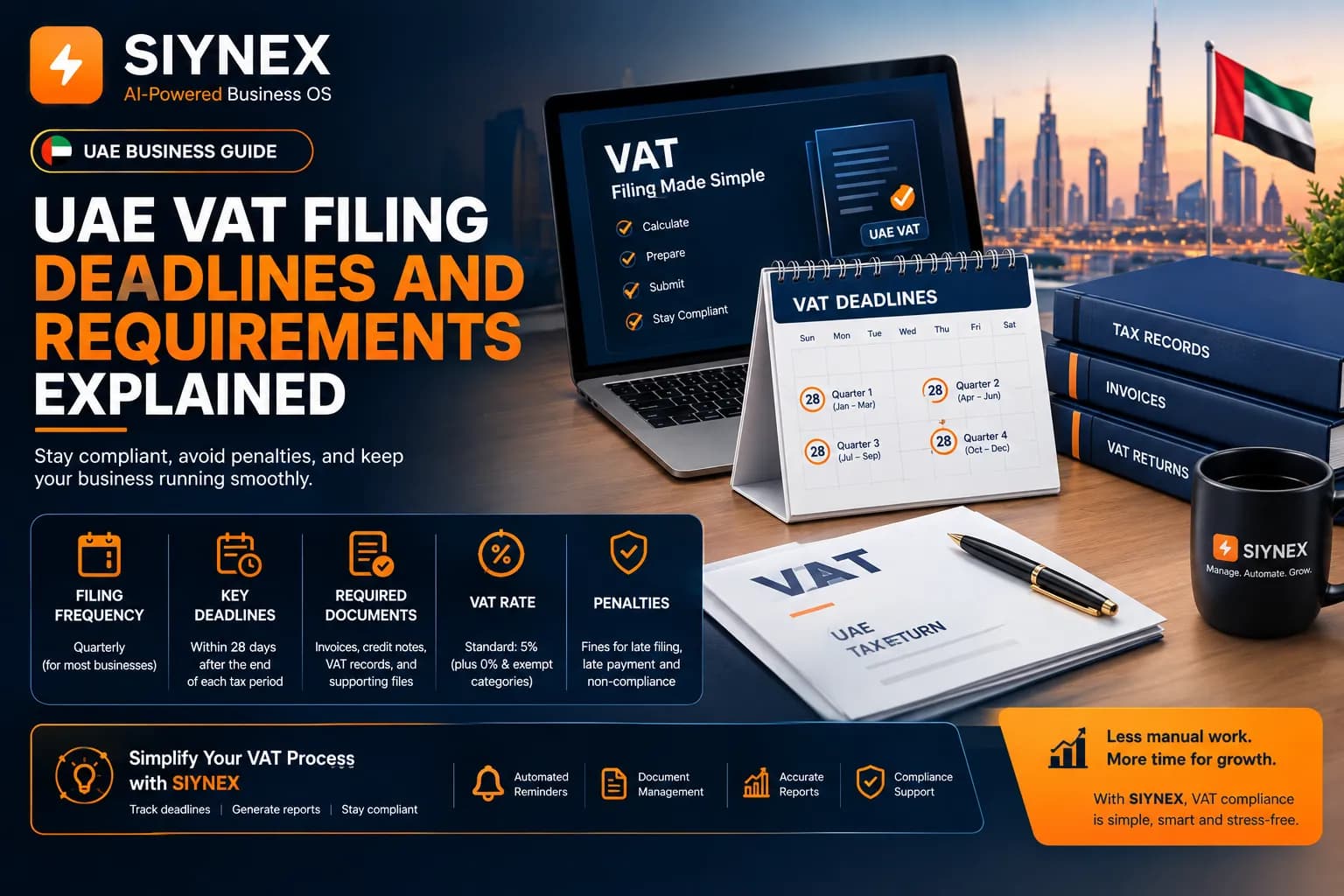
The deadline to file and pay your UAE VAT return is the 28th day of the month following the end of your tax period.
If the 28th falls on a UAE public holiday or weekend, the FTA typically extends the deadline to the next working day — but do not rely on this. File before the 28th.
For a business on the standard Q1 quarterly cycle:
| --- | --- |
|---|---|
| April – June | 28 July |
| July – September | 28 October |
| October – December | 28 January (of the following year) |
The deadline is the 28th of the month following the period end — so a January monthly period is due by 28 February, a February period by 28 March, and so on.
The deadline applies to both filing and payment simultaneously. Your return must be submitted and any VAT due must be paid by the 28th. Submitting the return on time but paying late still triggers a late payment penalty. Paying on time but submitting late still triggers a late filing penalty. Both must happen by the deadline.
What Does a UAE VAT Return Include?
The UAE VAT return on EmaraTax is a structured declaration of your output VAT (VAT you have charged to customers) and input VAT (VAT you have paid to suppliers) for the tax period, resulting in a net VAT payable or refundable position.
Here is what each section covers:
Box 1 — Standard Rated Supplies (UAE)
The total value of your supplies within the UAE subject to the standard 5% VAT rate, and the output VAT charged on those supplies. This comes from your issued tax invoices for the period.
Box 2 — Zero-Rated Supplies
The total value of supplies you made that are subject to VAT at 0% — exports outside the UAE, international transport, certain food items, healthcare, and education. These are included in the return to establish your total supply position, even though no output VAT is due.
Box 3 — Exempt Supplies
The total value of supplies that are exempt from VAT altogether — bare land, first supply of residential property, local passenger transport. Exempt supplies are included in the return but generate no VAT output.
Box 4 — Goods Imported into UAE (under Reverse Charge)
If your business imports goods or services from outside the UAE, the reverse charge mechanism applies. You declare the VAT on these imports as output VAT in Box 4, and reclaim the same amount as input VAT in Box 9 — resulting in a net neutral position in most cases, but it must still be declared.
Box 5 — Total Taxable Supplies and Imports
The combined total of standard-rated, zero-rated, and imported supplies. This is your gross taxable activity for the period.
Box 6 — Total Output VAT
The total VAT charged across all taxable supplies and imports. This is what you owe the FTA before deducting your recoverable input VAT.
Box 7 — Standard Rated Expenses (Recoverable Input VAT)
The total value of purchases, expenses, and imports on which you paid 5% VAT and are entitled to reclaim. Only purchases supported by valid UAE tax invoices (with all FTA mandatory fields) can be included here. Input VAT on personal expenses, entertainment (above 50%), and purchases from non-VAT-registered suppliers cannot be claimed.
Box 8 — Supplies Subject to VAT on Reverse Charge Basis
The input VAT you are reclaiming on imports and reverse charge supplies declared in Box 4.
Box 9 — Total Recoverable Input VAT
The sum of recoverable input VAT from Boxes 7 and 8.
Box 10 — Net VAT Due
Box 6 minus Box 9. If positive, this is the VAT you owe the FTA. If negative, you have a VAT refund position — you paid more VAT to suppliers than you collected from customers.
Box 11 — Tax Refunds Requested
If your return shows a refund position (Box 10 is negative), you can request a refund or carry the credit forward to offset future VAT liabilities. Most businesses carry credits forward rather than requesting refunds, as the refund process takes longer.
How to File a UAE VAT Return on EmaraTax — Step by Step
Step 1 — Log into EmaraTax
Access the FTA's portal at tax.gov.ae and log in with your credentials. Navigate to the VAT section and select "VAT Return" for the relevant tax period.
Step 2 — Gather Your Records Before You Start
Before opening the return form, have the following ready:
- Total value of all tax invoices issued during the period (output — your sales)
- Total VAT charged on those invoices (your output VAT)
- Breakdown of zero-rated and exempt supplies (if any)
- Total value of all supplier invoices received and paid during the period (input)
- Total input VAT on those invoices — only from VAT-registered suppliers with compliant tax invoices
- Total value and VAT on imports (if applicable)
- Any credit notes issued or received during the period
- Comparison with the previous period's closing position
Step 3 — Enter Your Output VAT Data
Complete Boxes 1 through 6. Enter each category of supply separately. Cross-reference against your sales records and issued invoices. The figures in your return must reconcile to your accounting records — discrepancies between your declared output and your invoiced amounts are a red flag in an FTA audit.
Step 4 — Enter Your Input VAT Data
Complete Boxes 7 through 9. Enter only VAT you can legitimately recover — supported by compliant tax invoices from VAT-registered suppliers, for purchases made wholly or partly for business purposes. Do not include:
- VAT on purchases for personal use
- VAT on expenses blocked by UAE VAT law (entertainment above 50%, motor vehicles for personal use)
- VAT on invoices that are not FTA-compliant (missing TRN, wrong VAT rate, labelled "Invoice" not "Tax Invoice")
Step 5 — Review the Net Position (Box 10)
Check that Box 10 (Net VAT Due) matches your own calculation. Run through your figures once. The most common errors are: transposing figures between boxes, including non-recoverable input VAT, or omitting a category of supply. A calculation error discovered before submission is free to fix. The same error discovered by the FTA after submission is a penalty.
Step 6 — Submit the Return
Confirm the return and submit on EmaraTax. You will receive a confirmation reference number. Save this reference — it is your evidence of submission.
Step 7 — Pay Any VAT Due
If Box 10 shows a positive balance (net VAT payable), make payment through EmaraTax's integrated payment system using credit/debit card or bank transfer. Ensure payment is processed and confirmed before the deadline — not just initiated.
Step 8 — File the Confirmation in Your Records
Save the submission confirmation, the payment confirmation, and a copy of the completed return. Maintain these for the FTA's minimum 5-year retention period. If you use SIYNEX, all of this is stored automatically and linked to the relevant transaction records.
UAE VAT Penalties — The Numbers You Need to Know
The FTA's penalty framework for VAT is specific, published, and applied without discretion. Here is what non-compliance costs.
Late VAT Return Filing:
| --- | --- |
|---|---|
| Each subsequent month | AED 2,000 per month |
| Maximum cumulative penalty | No published cap — accrues indefinitely |
| --- | --- |
|---|---|
| After 7 days | Additional 4% of unpaid tax |
| Monthly (from day 1 of the following month) | 1% per month on unpaid balance |
| --- | --- |
|---|---|
| Issuing a non-compliant tax invoice | AED 5,000 per invoice |
| Failure to issue a tax invoice | AED 5,000 per transaction |
| Incorrect VAT return (understated output or overstated input) | Between 50% and 400% of the understated tax, depending on the nature of the error |
| Failure to maintain required records | AED 10,000 (first instance) / AED 50,000 (repeat within 2 years) |
| Failure to submit a VAT return | AED 1,000 (first instance) / AED 2,000 (subsequent) per return |
The FTA's Voluntary Disclosure mechanism allows businesses to self-correct errors and underpayments before an audit. Penalties for voluntary disclosures are significantly lower than penalties for errors discovered by the FTA. If you identify an error in a previously filed return, voluntary disclosure is the correct and commercially rational response — not ignoring it and hoping it is not found.
What the FTA Checks During a VAT Audit
Understanding what the FTA looks for helps you maintain records that withstand scrutiny.
Output VAT reconciliation: The FTA will compare your declared output VAT against your bank deposits, issued invoices, and any third-party data sources. Unexplained discrepancies between your declared turnover and your bank activity are the most common audit trigger.
Input VAT legitimacy: Every input VAT claim will be checked against the supporting invoice. An invoice that does not carry a valid TRN, is labelled "Invoice" instead of "Tax Invoice," is from a supplier who is not VAT-registered, or does not include all FTA mandatory fields will be disallowed. The VAT on that invoice becomes irrecoverable, and if you have already claimed it, the return will be amended and penalty interest applied.
Sequential invoice numbering: Gaps in your invoice sequence are a red flag — they suggest invoices may have been issued but not declared. The FTA may request all invoices in a given range and compare them against your declared output.
Reverse charge compliance: If your business imports services (software, consultancy, cloud services from overseas providers), the reverse charge mechanism applies. Many UAE businesses are unaware of this obligation. An FTA audit will check whether reverse charge has been correctly applied to imports.
Reconciliation between VAT returns and financial statements: Your total declared VAT supplies across four quarters should reconcile to your annual revenue in your financial statements. A material discrepancy is an audit trigger.
Voluntary Disclosure — When and How to Use It
A voluntary disclosure is a formal mechanism through EmaraTax that allows a VAT-registered business to correct a previous return — whether to declare additional output VAT, correct an input VAT overclaim, or adjust any other filed figure.
When to make a voluntary disclosure:
- You discover that output VAT was understated in a previous return (you forgot to include a supply, applied the wrong rate, or did not declare a supply at all)
- You discover that input VAT was overclaimed (you included a non-compliant invoice, claimed VAT on a blocked expense, or made a calculation error)
- You receive a credit note that changes the VAT position of a previous period
- You identify any other error in a previously filed return
Voluntary disclosure penalties are reduced compared to audit-discovered errors:
- For voluntary disclosure within the tax period in which the error occurred: no penalty on the tax amount (only the standard late payment interest if additional tax is due)
- For voluntary disclosure after the tax period: penalty of 5% of the additional tax for each year of delay (capped at 25% of the additional tax)
- For FTA-discovered errors: penalty of 30% to 300% of the additional tax, depending on the nature and circumstances
The message is clear: self-correct proactively, not reactively. An error that you find and disclose costs you much less than the same error found by the FTA.
How to make a voluntary disclosure:
Log into EmaraTax, navigate to your VAT section, and select "Voluntary Disclosure." Complete the form with the period being corrected, the nature of the error, the original and corrected figures, and the reason for the disclosure. Submit and pay any additional tax due.
VAT Refunds — When You Are in a Reclaim Position
Not every VAT return results in a payment to the FTA. If your input VAT for a period exceeds your output VAT — common for businesses that make predominantly zero-rated supplies (exporters, businesses supplying international clients) — your return will show a net credit position.
You have two options with a VAT credit balance:
Carry forward: The credit is held on your EmaraTax account and automatically offset against your next VAT liability. This is the simplest option for businesses with regular VAT payments — the credit will be absorbed within one or two future quarters.
Request a refund: You can formally request a cash refund of your VAT credit balance through EmaraTax. The FTA reviews refund requests and will often conduct a verification process before releasing funds. Refunds can take 20 business days for straightforward cases and longer for complex positions or businesses that have not been audited recently.
For exporters and zero-rated supply businesses: If your business regularly generates VAT credit positions — because you charge 0% VAT on exports but pay 5% on your UAE-based inputs — consider whether monthly filing would be beneficial. Monthly filers can request refunds or carry forward credits twelve times per year rather than four, improving cash flow.
Common UAE VAT Filing Mistakes — and How to Avoid Them
Including input VAT from non-compliant invoices
The most frequently disallowed input VAT claims come from invoices that fail FTA compliance requirements: missing TRN, wrong label, incorrect VAT rate, or issued by a supplier who is not VAT-registered. Validate supplier invoices at the time of receipt — not at return preparation time when it is too late to get a corrected invoice.
Omitting reverse charge on imported services
Cloud software subscriptions, overseas consultancy, international software licences — these are services imported into the UAE and subject to the reverse charge mechanism. Many businesses have been paying these invoices without applying reverse charge, creating an undeclared output VAT liability that accumulates quietly across every quarter.
Mixing personal and business expenses
Input VAT on personal expenses — owner's personal credit card charges coded to the business, personal travel, personal equipment — is not recoverable. Including it in your VAT return creates a disallowance risk in every audit.
Not reconciling return figures to accounting records
Your VAT return figures should reconcile precisely to your accounting system's VAT accounts. Running the return from a separate spreadsheet without reconciling to the general ledger introduces errors that compound across periods.
Filing without a complete record of credit notes
Credit notes issued to customers reduce your output VAT. Credit notes received from suppliers reduce your input VAT. Both must be included in the correct period's return. Businesses that issue or receive credit notes frequently sometimes omit them or include them in the wrong period — creating mismatches that audit reconciliations expose.
Waiting until the last day
The EmaraTax portal experiences high traffic on and around the 28th of filing months. Technical issues on the final day have caused genuine filing problems for businesses that left submission to the last hour. File at least five business days before the deadline. If a technical issue delays submission on the deadline day, document your attempt and contact the FTA immediately — but the safer approach is simply not to be in that position.
How SIYNEX Automates UAE VAT Compliance
Managing UAE VAT filing manually — gathering records from multiple systems, reconciling figures, calculating input and output VAT, filing on EmaraTax, and remembering four deadlines per year without fail — is a significant operational overhead for a small business. And when it goes wrong, it goes wrong expensively.
SIYNEX — the AI-powered Business Operating System for UAE SMEs — makes VAT compliance the default output of how your business operates, not a separate quarterly task.
Real-Time VAT Ledger
Every tax invoice created in SIYNEX automatically feeds into your VAT output ledger. Every compliant supplier invoice recorded feeds into your input VAT ledger. At any point in the quarter, you can see your real-time VAT position — output collected, input recoverable, and net position — without waiting until the return deadline to calculate it.
Invoice Compliance Validation
Before a supplier invoice is added to your records, SIYNEX validates that it meets FTA requirements: correct label, TRN format, VAT rate, and mandatory fields. Non-compliant invoices are flagged before they enter your input VAT claim — not discovered during an audit.
Automated Deadline Tracking and Reminders
Your VAT return deadlines are calculated from your assigned tax period and calendared in SIYNEX from day one. Reminders escalate at 28 days, 14 days, 7 days, and 3 days before each deadline. You will not miss a VAT deadline because you forgot — the system surfaces it repeatedly until it is filed.
Return Pre-Population
When your return period closes, SIYNEX pre-populates your VAT return data from your recorded invoices and transactions. You review the figures — output by category, input by category, net position — and confirm before filing. The return is already prepared. Your job is to review, not to build.
EmaraTax Integration
SIYNEX connects directly with EmaraTax for return submission. File your VAT return from within SIYNEX — no re-entering figures into a separate portal, no manual data transfer errors.
5-Year Record Retention
Every transaction, invoice, and return is retained in SIYNEX for the FTA's required 5-year minimum period, stored in its original format and retrievable instantly. When an FTA audit request arrives, you export your records from SIYNEX — not spend three days reconstructing a filing cabinet.
AI Compliance Assistant
SIYNEX's AI Compliance Assistant answers your VAT questions in real time: which supplies are zero-rated, whether a specific expense is recoverable, whether a supplier is VAT-registered, how to handle a reverse charge situation. Compliance answers are available when you need them — at the moment of a business decision, not days later when you finally reach your accountant.
See How SIYNEX Manages Your UAE VAT Filing →
UAE VAT Filing Calendar 2026 — Key Dates
For businesses on the standard Q1 quarterly cycle:
| --- | --- | --- |
|---|---|---|
| Q2 2026 | 1 April – 30 June 2026 | 28 July 2026 |
| Q3 2026 | 1 July – 30 September 2026 | 28 October 2026 |
| Q4 2026 | 1 October – 31 December 2026 | 28 January 2027 |
If your business is on a Q2 or Q3 cycle, your period end dates and deadlines shift accordingly — check your FTA registration confirmation.
Frequently Asked Questions
Q: What happens if I miss the UAE VAT return deadline?
The FTA applies an automatic late filing penalty of AED 1,000 for the first month and AED 2,000 for each subsequent month. A separate late payment penalty applies to any unpaid VAT — 2% of the unpaid tax on day 1, 4% after 7 days, and 1% per month from month 2 onwards. Both penalties run simultaneously if both the return and payment are late. There is no grace period and no warning notice before penalties begin accruing.
Q: Can I file a UAE VAT return if I had no sales in the quarter?
Yes — and you must. A VAT-registered business with zero sales in a quarter must still file a nil return for that period. Failure to file a nil return triggers the same late filing penalties as failure to file a return with actual figures. Log into EmaraTax, complete the return with zeros in all boxes, and submit by the deadline.
Q: How do I correct a mistake in a previously filed UAE VAT return?
Through EmaraTax's Voluntary Disclosure mechanism. Log in, navigate to Voluntary Disclosure under your VAT section, and complete the correction form for the relevant period. Penalties for voluntary disclosure are significantly lower than penalties for errors discovered by the FTA — self-correction is always the right approach when you identify an error.
Q: What is the UAE VAT reverse charge mechanism?
The reverse charge applies when a UAE VAT-registered business receives services from an overseas supplier who is not registered for UAE VAT (for example, a cloud software subscription or international consultancy service). The UAE business declares the VAT on the import as output VAT in Box 4 of the return and simultaneously reclaims the same amount as input VAT in Box 9 — usually resulting in a net neutral position. Many businesses are unaware of this obligation and are accumulating undeclared reverse charge liabilities.
Q: I am an exporter. My input VAT regularly exceeds my output VAT. What should I do?
Exporters making predominantly zero-rated supplies (0% output VAT) but incurring 5% input VAT on UAE purchases will regularly be in a VAT credit position. You can carry the credit forward to offset future liabilities or formally request a refund through EmaraTax. Consider applying to the FTA for monthly filing — monthly filers can recover input VAT credits twelve times per year instead of four, significantly improving cash flow.
Q: How long must I keep UAE VAT records?
The FTA requires VAT records — including all tax invoices issued and received, VAT returns, credit notes, import documents, and bank records supporting VAT transactions — to be retained for a minimum of 5 years from the end of the tax period to which they relate. For real estate transactions, the retention period is 15 years. Records must be in their original format — not converted to a different format — and retrievable on FTA request.
Q: What is the difference between VAT deregistration and not filing?
VAT deregistration is a formal process through EmaraTax that removes your VAT registration when your taxable supplies fall below the voluntary deregistration threshold (AED 187,500 annually) or when your business ceases to make taxable supplies. Until deregistration is formally confirmed by the FTA, you remain registered and must continue filing returns. Not filing because you believe you should be deregistered is not a valid position — it results in late filing penalties. Always formally deregister through EmaraTax, receive confirmation, and only then stop filing.
Summary: UAE VAT Filing — What You Must Do Every Quarter
UAE VAT filing is not complicated once the process is understood and the records are maintained properly throughout the quarter. The businesses that struggle with VAT compliance are almost always the ones that treat it as a quarterly emergency — scrambling to gather records, calculate figures, and file at the last minute — rather than an ongoing discipline where the data is current, the figures are always known, and filing is a review exercise rather than a reconstruction effort.
Your non-negotiable quarterly checklist:
- [ ] All tax invoices issued in the period are recorded and output VAT is accumulated
- [ ] All supplier invoices received are checked for FTA compliance before input VAT is claimed
- [ ] Reverse charge is applied to any overseas service purchases
- [ ] Credit notes issued and received are recorded in the correct period
- [ ] Return figures are reconciled to your accounting records
- [ ] Return is filed on EmaraTax before the 28th of the month following period end
- [ ] VAT due is paid through EmaraTax by the same deadline
- [ ] Submission and payment confirmations are saved in your records
Do this four times a year, every year, without exception. The penalty for getting it wrong is immediate, automatic, and compounding. The reward for getting it right is a clean compliance record, a business the FTA has no reason to audit, and a finance team that spends its time on business growth rather than compliance recovery.
SIYNEX makes this process the default output of how your business operates — not a quarterly task you have to remember to do.
Start Managing Your UAE VAT Compliance with SIYNEX →
Last updated: June 2026 | This article reflects UAE VAT law under Federal Decree-Law No. 8 of 2017 and FTA penalty framework as of the publication date. Penalty figures and filing requirements are subject to change — always verify current requirements on the FTA's EmaraTax portal (tax.gov.ae) and consult a UAE-registered tax agent for advice specific to your business. This article does not constitute tax or legal advice.